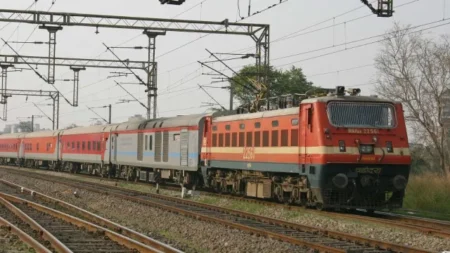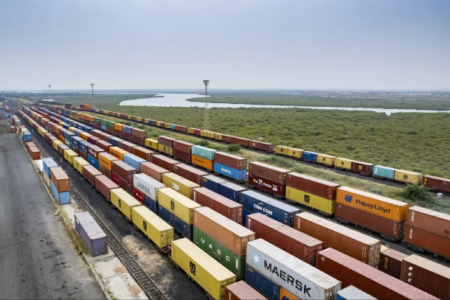



The Delhi roundtable warns freight emissions may double without coordinated policy beyond short-term incentives.
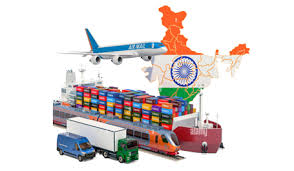
A coordinated national policy framework, not standalone incentives, is critical to decarbonising India’s long-haul freight sector, experts said at a high-level closed-door roundtable in New Delhi on February 26, 2026. Without timely intervention, the sector’s emissions are projected to more than double by mid-century.
The meeting brought together senior policymakers, industry leaders, researchers, and financiers at the India International Centre during Delhi Climate Innovation Week. The roundtable was organised by Riding Sunbeams and Purpose to map near-term decarbonisation pathways for road and rail freight.
Discussions were structured around three priority areas: fuel efficiency norms and regulatory ecosystems, technology and innovation readiness, and investment pathways required for system-wide action.
Opening the session, Rahul Kapoor, Director (Finance) at the Dedicated Freight Corridor Corporation of India, cautioned against siloed policymaking. He emphasised that scaling successful pilots across India requires an integrated approach spanning technology, policy ecosystems, human resources, economics and livelihoods, with alignment between the Centre and state governments to enable affordable innovation.
From a regulatory perspective, Amit Bhatt, Managing Director at ICCT India, acknowledged growing momentum in freight decarbonisation but warned against dependence on short-term incentives. He noted that while incentives can provide an initial push, long-term impact depends on clear, strategic policy pathways that define the role of each transport mode and set measurable targets for different technologies.
Electrification of road freight raised fresh infrastructure questions. Kaustubh Gosavi, Program Lead for Electric Mobility at WRI India, highlighted that nearly 10,000 electric trucks are expected to be deployed over the next five years. He flagged the implications for grid load, the need for energy system readiness, and the integration of renewable power while maintaining commercial viability.
Participants also assessed the readiness of alternative-fuel heavy-duty vehicles, grid and charging infrastructure, multimodal logistics optimisation, and the role of concessional and catalytic finance. There was broad consensus on the need to create demand certainty, reduce risks for early adopters, and deepen public–private collaboration.
Summing up the urgency, Mahak Agrawal, India Lead at Riding Sunbeams, said the session was designed as a working forum to identify practical bottlenecks and investable solutions, stressing that freight must move from the margins to the mainstream of India’s climate strategy to achieve credible net-zero pathways.
The roundtable concluded with participants agreeing to produce a detailed briefing note capturing key insights, areas of convergence and recommended next steps. Riding Sunbeams is a UK-based initiative integrating solar power into railway traction systems, with its India work focused on achieving net-zero rail by 2030, while Purpose operates globally across climate, health and social justice initiatives.
Source: Autocar Professional