



India’s first comprehensive semiconductor industry roadmap targets a USD 120–150 billion value chain by 2035 built across five strategic pillars.
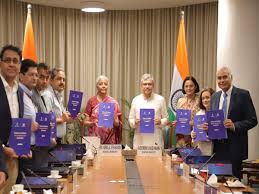
NITI Aayog’s Frontier Tech Hub released India’s first comprehensive 10-year semiconductor roadmap titled “Future of India’s Semiconductor Industry” on May 29, 2026. The roadmap was unveiled by Finance and Corporate Affairs Minister, Shrimati Nirmala Sitharaman and Minister for Railways, Information and Broadcasting and Electronics and Information Technology, Shri Ashwini Vaishnaw, in the presence of NITI Aayog Vice Chairman, Shri Ashok Lahiri, Distinguished Fellow Debjani Ghosh and India Semiconductor Mission Chief Executive Officer Amitesh Kumar Sinha, alongside members of the Expert Council and senior industry and government representatives. The roadmap sets out a vision for India to build a USD 120–150 billion semiconductor value chain by 2035 and is built around five mutually reinforcing pillars: pioneering frontier research and development and design intellectual property; policy and investment to mobilise long-horizon capital; production focused on advanced packaging and compound semiconductors; people across the full semiconductor talent pyramid; and partnerships with trusted nations and global industry. Key goals include positioning India as a leading global destination for advanced packaging and Outsourced Semiconductor Assembly and Test (OSAT), emerging as a major supplier of wide-bandgap semiconductors, building leadership in compound semiconductor manufacturing and creating more than 100 advanced semiconductor design intellectual properties.
The roadmap directly reinforces priorities announced under the India Semiconductor Mission 2.0 in the Union Budget 2026 and marks a shift from ecosystem creation to ecosystem deepening across design, materials, manufacturing, packaging, talent and trusted global partnerships. Sitharaman said the roadmap “is a clear declaration of India’s intent to move decisively from being a major consumer of chips to becoming an indispensable part of the global semiconductor value chain,” highlighting advanced packaging, compound semiconductors, wide-bandgap materials and AI-native chip design as areas where India can build strong positions. Vaishnaw stated that design is “our clear number one priority” under ISM 2.0 and described the semiconductor journey as “a 20-year journey” central to India’s technological sovereignty and strategic autonomy. Lahiri said India’s dependence on technology controlled by others is “one of the biggest risks India carries today” and that semiconductor leadership is part of the foundation of sovereignty. Ghosh described the roadmap as a “practical ten-year pathway that helps India move beyond participation to strategic depth.”
Source: Press Information Bureau (PIB)