


The Department of Drinking Water and Sanitation convenes the 10th District Collectors’ Peyjal Samvad via video conferencing on July 14, 2026, with five districts showcasing best practices in sustainable rural water service delivery under Jal Jeevan Mission 2.0
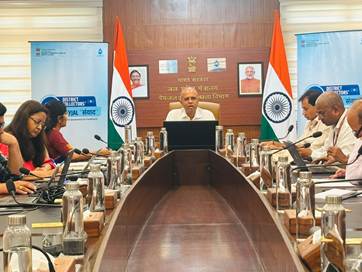
The Department of Drinking Water and Sanitation (DDWS), Ministry of Jal Shakti, organised the 10th edition of the District Collectors’ Peyjal Samvad on July 14, 2026 through video conferencing, bringing together senior officials, District Collectors and Deputy Commissioners and Mission Directors of states and union territories to deliberate on accelerating implementation of Jal Jeevan Mission (JJM) 2.0.
The Samvad was chaired by Ashok K.K. Meena, Secretary, DDWS, with Kamal Kishore Soan, Additional Secretary and Mission Director, National Jal Jeevan Mission (NJJM), also participating. Meena stated that JJM has entered a new phase where the focus has shifted from infrastructure creation to assured and sustainable rural piped water service delivery through community-led governance, described as Jan Bhagidari. He called upon states and districts to accelerate certification of Har Ghar Jal Gram Panchayats, institutionalise Jal Arpan as an annual community-led event and directed officials to ensure digital mapping of all rural water supply assets through the Sujalam Bharat Digital Registry, integrated with the PM Gati Shakti portal. He noted that over 1.17 lakh activities have been executed nationwide under Jal Seva Aankalan. The role of 16th Finance Commission Grants for Water, Sanitation and Hygiene (WaSH) in strengthening sustainability of rural drinking water and sanitation services was also highlighted.
Best practices from five selected districts were presented by the respective District Collectors and District Magistrates. Kinnaur, Himachal Pradesh achieved 100% Har Ghar Jal coverage across all 210 villages through source augmentation, snow-water harvesting and groundwater recharge despite mountainous terrain. Haveri, Karnataka achieved 95.36% Functional Household Tap Connection (FHTC) coverage and declared six villages as 24×7 water supply villages under large Multi Village Schemes on the Design-Build-Operate-Transfer model, supported by the Jeeva Jala mobile application for water quality monitoring. Dumka, Jharkhand established an Integrated Control Room and strengthened grievance redressal through Jan Bhagidari, Jal Arpan Divas and Jal Sahiyas. South Goa, Goa completed all 118 JJM works and is meeting nearly 96% of the state’s drinking water demand through surface water-based regional supply systems, with IoT-enabled monitoring, SCADA systems and smart metering in place. Unakoti, Tripura achieved 89.16% FHTC coverage benefiting over 47,800 households and implemented the Kaligiri surface water project to replace seasonal and tanker-based supplies with sustainable piped drinking water in remote border villages.
Source: Press Information Bureau (PIB)