


If there is one industry watching India’s manufacturing rise most closely, it is aviation. Aaron Tayler, Regional Director, Air Cargo Market Analysis, Boeing Commercial Airplanes frames India’s trajectory in striking terms: manufacturing has grown at more than 7 percent annually since 2000, propelled further by Make in India and production-linked incentive schemes. The country now ranks as the world’s fifth-largest manufacturing economy and the second-largest producer of smartphones, while its pharmaceutical sector pushes beyond generics into biosimilars and next-generation therapies. As that industrial base climbs the value chain, Tayler argues, its dependence on air cargo climbs with it- high-value, high-tech goods overwhelmingly move by air precisely because speed, reliability and security are non-negotiable.

AIR CARGO POWERS INDIA’S MANUFACTURING ASCENT.
Demand That Bends but Doesn’t Break
The figures bear this out. Air cargo demand in India already sits more than 25 percent above its pre-pandemic peak, with the country targeting over 10 million tonnes of cargo handled by the early 2030s. Even the March 2026 Middle East conflict, which briefly dented demand, could not derail the broader trend- the market rebounded from April as networks rerouted around disrupted airspace, and by May global demand was up 4 percent year-on-year, with Asia-Europe traffic climbing 11 percent and Transpacific lanes growing 7 percent on semiconductor and AI-related shipments.
The Freighter Capacity Gap
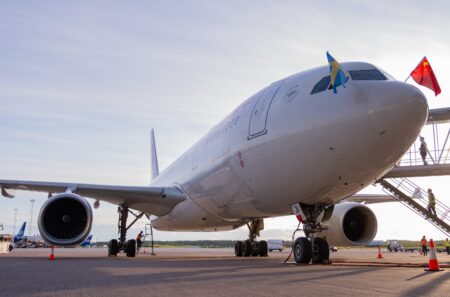
The structural gap, Tayler notes, lies in freighter capacity. Indian carriers currently operate fewer than 20 standard-body freighters and carried only around a fifth of the country’s international cargo in 2025, leaving roughly 80 percent to international wide-body operators. He forecasts India’s freighter fleet expanding to more than 100 aircraft in the coming decades- a build-out he considers essential to India’s manufacturing ambitions.