


Union Minister, Shri Ashwini Vaishnaw has announced that India’s semiconductor mission is entering its next phase under ISM 2.0, focusing on building a complete semiconductor ecosystem across six key pillars.
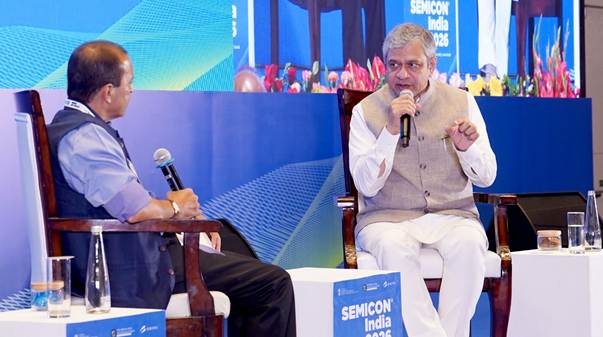
Union Minister for Electronics and Information Technology Ashwini Vaishnaw said at Semicon India 2026 that India’s semiconductor mission had moved from establishing the foundation to building the industry at scale. Speaking at a fireside chat, Vaishnaw said India Semiconductor Mission 1.0, originally envisaged as a six-year programme, achieved its objectives in just four years, and that ISM 2.0 would focus on developing a complete semiconductor ecosystem across six pillars: design, materials and machines, more fabrication facilities, more assembly, testing, marking and packaging units, research and development and talent. Five semiconductor manufacturing plants have commenced commercial production in India, with chips being exported in addition to meeting domestic needs. A fabrication facility scheduled for commissioning in 2028 already has a large part of its capacity booked.
Vaishnaw said India had initially set a target of training 85,000 design engineers in 10 years and had already trained around 70,000 within four years, with students from around 400 engineering colleges receiving access to industry-grade electronic design automation tools. More than 105 chip design startups gained access to electronic design automation tools under ISM 1.0, while 20 startups received venture capital funding. Under ISM 2.0, at least 200 chip design companies are expected to emerge, which Vaishnaw described as a game changer for building homegrown semiconductor intellectual property. He also noted that ATMP units are already exporting to Japan, while chips are being incorporated into products exported to the United States and EU countries such as Switzerland and Germany, and that major server manufacturers are showing interest in setting up manufacturing in India.
Source: Press Information Bureau