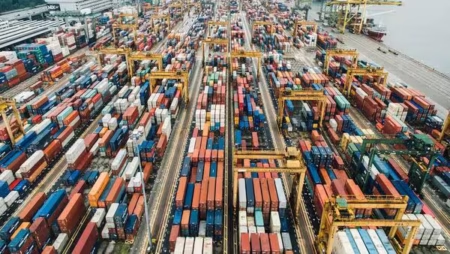




Indian supply chain executives are now prioritising backup suppliers and larger inventories over pure cost efficiency, writes Rahul Arora, Managing Director of Jasper Group. Rerouted shipments, swollen cold chains and rising policy uncertainty are reshaping strategy, companies trading lean networks for ones that can absorb a shock and keep delivering.

Seventy per cent of Indian supply chain executives now say lining up backup suppliers matters more than shaving costs, and fifty-nine per cent are carrying more inventory than two years ago, according to a survey of 451 supply chain and logistics executives across the country, writes Rahul Arora, Managing Director of Jasper Group. This is not a group being cautious out of habit. These are the people who move goods for a living, and they rewrote their own playbook.
The Shortest Route Is No Longer the Safest One
This plays out in unglamorous ways. A shipment of frozen prawns gets rerouted around the Cape of Good Hope and arrives ten to fourteen days late. A cold storage facility carries more stock than any planner would have signed off on five years ago, because nobody wants to explain an empty shelf to a customer with other options. What used to sit quietly in a risk register has become the thing companies actually plan around.
The Suez Canal carries roughly 15 per cent of global maritime trade in a normal year. Since Houthi attacks began hitting the Red Sea corridor, much of that traffic has gone round Africa instead, and shipping lines have still not returned to normal. For anything perishable, that extra time means spoilage risk, more cold storage rent and a customer already gone elsewhere by the time cargo lands. Pharma, electronics and food companies are now planning around the idea that something will go wrong.
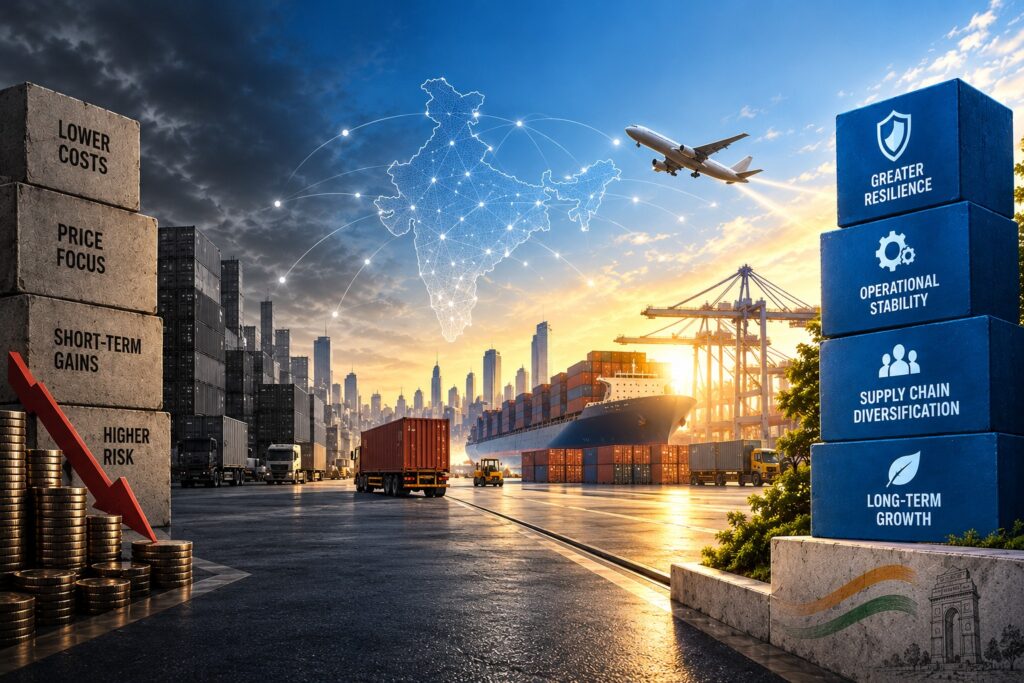
Inventory Stops Being the Thing Everyone Shrinks
Inventory has stopped being the thing everyone tries to shrink. Data on roughly 2,200 Indian manufacturers shows inventory days barely moved, from 56 to 57 over the year to March 2026. That small shift hides a bigger one: import-heavy sectors, especially electronics and consumer durables, have stocked up well beyond usual levels, whatever the cost. Ready-to-eat food makers feel this hardest, since a pallet of frozen paratha cannot wait for a shipping lane to sort itself out. Sourcing has moved closer to processing units, with backup built into cold chains rather than trusting one transporter.
Where India Fits Into the Picture
There is a mix of confidence and nervousness in how Indian companies see this. Seventy-nine per cent of executives here expect trade to pick up through 2026, against 54 per cent globally, yet 60 per cent also expect policy uncertainty, above the global figure of 53 per cent. Government backing for food processing, including cold chain support under the Pradhan Mantri Kisan Sampada Yojana, has helped, but no scheme alone makes a supply chain resilient.
What Comes Next
Cost still matters and always will, but Covid, the Red Sea and recurring tension across West Asia have made one thing hard to argue with: a supply chain built only around cost eventually fails at the worst possible time. The companies that come out ahead will not be the ones with the leanest network on a spreadsheet, but the ones that can take a hit, keep goods moving and still turn up for customers.