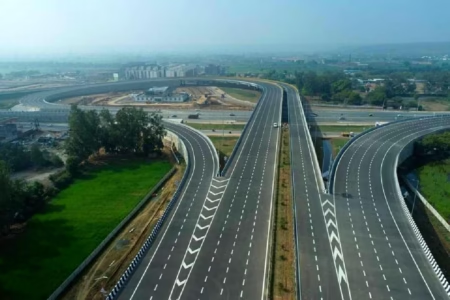





India’s logistics challenge is no longer just about building infrastructure but about synchronising warehousing, transportation and fulfilment into a single, demand-driven network. As consumption accelerates and volatility becomes the norm, competitive advantage will come from flow efficiency, replenishment intelligence and execution speed rather than warehouse size alone.

The Infrastructure-Efficiency Gap
India is investing heavily in infrastructure but warehousing maturity remains deeply uneven across the country. Kartik Mewada, Senior Program Manager, Last Mile at Blinkit, observes this tension clearly from the front lines of one of India’s fastest-scaling quick commerce operations. World-class freight corridors are being built while many supply chains continue to operate with fragmented warehouse networks, poor inventory planning and disconnected city-level operations. The infrastructure is arriving but the operational standardisation that gives it meaning is lagging behind.
The comparison with China is instructive. China’s logistics evolution worked because infrastructure and consumption density evolved together. In India, consumption is scaling faster than operational standardisation and that asymmetry is creating a specific kind of inefficiency that more warehouses alone will not fix. A facility outside the city may look efficient on paper but if replenishment cycles slow down or last-mile operations become unstable, total network cost actually rises. The problem is not always where you think it is.
Designing Backwards from Demand
The most important insight Mewada draws from operating at the pace and scale of quick commerce is that infrastructure does not create efficiency, network design does. The best logistics networks in fast-moving businesses are designed backwards from customer demand rather than forward from infrastructure availability. A truly integrated warehouse is one where transportation, replenishment, inventory visibility and fulfilment are connected in real time. The warehouse should not behave like a static storage asset but rather like a traffic control system for inventory, sensing demand signals and responding before gaps appear rather than after they have already cost money and time.
At the scale Blinkit operates, even a few hours of replenishment delay has measurable consequences on customer experience, rider efficiency and working capital. That sensitivity is sharpening the industry’s thinking about what warehousing performance actually means. Storage utilisation and dispatch timelines, the traditional measures of warehouse performance, are giving way to inventory accuracy, replenishment intelligence, prediction-based planning and execution speed as the metrics that actually determine competitive outcomes.
Absorbing Volatility at Scale
The Indian market presents a particular challenge in this regard. Demand patterns here are extraordinarily dynamic. A cricket match, unexpected rainfall, salary week or a local festival can completely reshape consumption behaviour within hours. The strongest warehouse networks in this environment are not necessarily the most automated but the ones that can absorb volatility without losing execution discipline, systems that can react faster, replenish smarter and hold their rhythm even when demand moves in directions the planning model did not anticipate.
This points to a broader structural shift that Mewada believes will define the next phase of Indian logistics. The sector currently has an execution synchronisation problem more than an infrastructure shortage problem. Warehousing, transportation, sourcing and last-mile operations still run in silos across many businesses. The companies that will win over the next decade are those that create a single operating rhythm across all these functions, moving from asset-focused thinking to flow-focused thinking where the speed and predictability of inventory movement matters more than the size of any individual facility.
If India is serious about reducing logistics costs meaningfully, that shift in thinking is not optional. It is the work that the infrastructure build-out alone cannot do and it is where the real competitive differentiation will emerge in the years ahead.
The grid is being built. But as the next voice in this conversation makes clear, what sits inside that grid matters just as much as the grid itself.