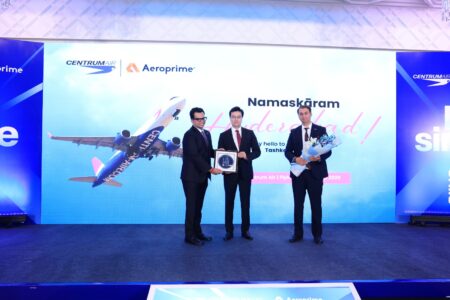





Abhishek Goyal, CEO & Executive Director, Aeroprime Group describes air freight’s evolution plainly: it has become a strategic contingency rather than a premium option of last resort. While some multinational shippers still deal directly with airlines through global contracts, a meaningful share of the shift away from unreliable ocean lanes flows through GSSAs like Aeroprime, which bring local market reach, commercial agility and distribution capability that airlines depend on- reinforced, he notes, by IATA data showing sustained growth in global air cargo demand driven by e-commerce, disruption and modal shift.

BALANCE, NOT VOLUME ALONE, DRIVES CARGO YIELD.
Responding to the Middle East Shock
Aeroprime’s role, in Goyal’s telling, extends well beyond selling capacity: consolidating demand across customer segments, optimising loads, and helping airlines improve yield while keeping shippers connected to reliable air freight options. That agility was tested directly when Middle East international cargo traffic contracted by more than 54 percent in March 2026 amid regional conflict. Working through interline partnerships and regional hub connectivity, Aeroprime helped partner airlines identify alternative demand and revised routings- a response Goyal points to as proof that constrained capacity, per IATA, typically strengthens yields for operators nimble enough to realign quickly.
Balancing E-Commerce and Industrial Cargo
That same balancing instinct applies to capacity allocation itself. With e-commerce now accounting for 25 to 30 percent of global air freight tonnage- up from under 15 percent in 2019- Goyal’s team weighs high-volume e-commerce traffic against higher-yield, time-critical industrial cargo from pharmaceuticals, automotive, aerospace and electronics, optimising the airline’s overall cargo mix rather than chasing volume alone.
Turning Regulation into Operational Speed
Regulatory agility rounds out Aeroprime’s value proposition. As government liaison, the firm acts as the bridge between airlines, regulators, ground handlers and forwarders whenever customs or screening requirements tighten, translating new rules into operational guidance before they disrupt cargo flow- because, in Goyal’s view, speed of execution matters as much as compliance itself.