

Some voyages are charted by the stars. Others are found in a temple queue at two in the morning, in a gold chain with a Balaji locket, in the quiet courage of a woman who had never flown before boarding a ship in the middle of the Atlantic.
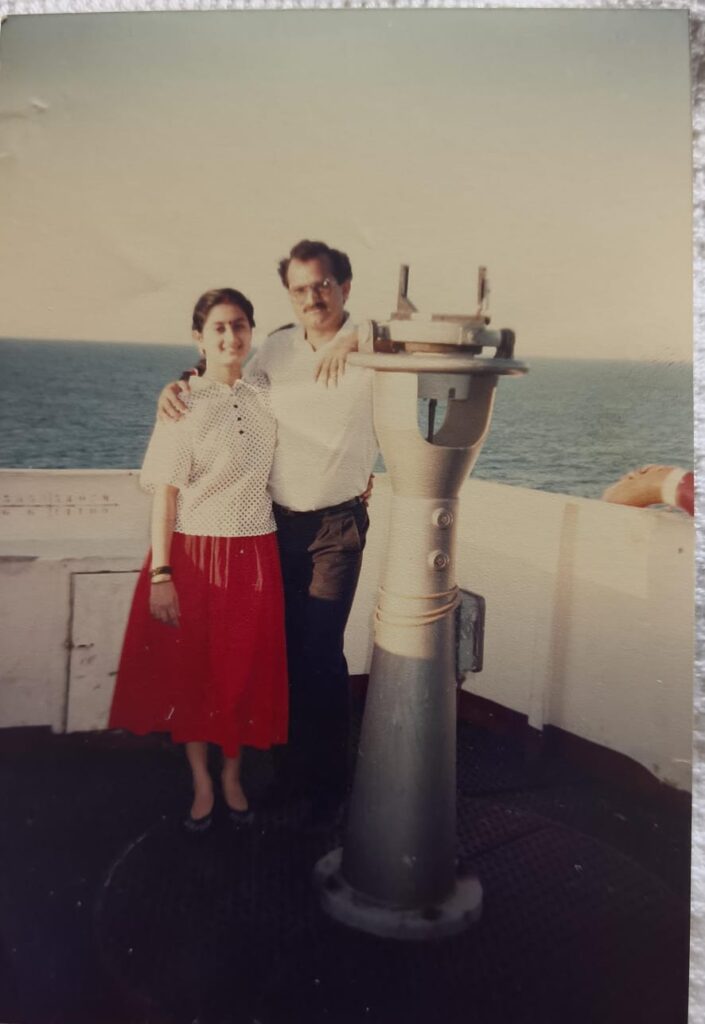
After years of navigating oceans, facing storms and living with uncertainty at sea, I discovered that the most important voyage of my life did not begin on the bridge of a ship. It began on land, with faith, family and a remarkable woman who would become my life’s greatest strength.
When Destiny Stepped Ashore
The Merchant Navy had taught me discipline, resilience and self-reliance. Life at sea meant spending months away from home, making critical decisions in isolation and learning to trust one’s judgment under immense pressure.
Bhanu came from an entirely different world. She was deeply devoted to Indian classical music, working with All India Radio in the Commercial Broadcasting section, and living a life centred around culture, devotion and simplicity. Her Station Director thought the world of her. On the surface, our professions could not have been more different. Mine demanded months at sea navigating oceans I could not always name in advance. Hers was built around a studio, a microphone and the discipline of riyaz. Yet we shared the same values: humility, commitment, integrity and faith.
Looking back today, I realise that lasting partnerships are built not on similar professions, but on shared principles.
Where Faith Became Destiny
In October 1988, during a family pilgrimage to Tirumala, an unexpected experience changed the course of my life. I had travelled up with my younger brother, and we had settled into accommodation at the Tirumala Hills. The weather, unusually pleasant for early October, seemed almost designed for what was to come.
Late in the night, Bhanu planned to perform Angapradakshinam, the sacred ritual of offering complete surrender before Lord Venkateswara, along with a family friend’s colleague. When that companion dropped out at the last moment, she would not go alone. In the pitch dark of the room, she tapped my leg to wake me and asked, in a voice barely above a whisper, whether I would accompany her.
I had never imagined undertaking the ritual myself.
After taking a holy dip in Swami Pushkarini, we joined the separate queues before dawn, standing in the cold with wet clothes clinging to us in the night wind. Hundreds of devotees, young and old, moved forward in complete faith, rolling around the temple in prayer. The journey tested every ounce of physical endurance. There were moments when I wanted to stop, and I very nearly did, still in the queue, ready to walk away. Yet something kept urging me forward, and someone behind me gave a gentle, encouraging nudge at precisely the right moment.
When the ritual ended nearly two hundred metres later, to the chants of Govinda Govinda, I felt transformed. The exhaustion had disappeared. In its place was an indescribable sense of peace and clarity.
That evening, while our families were discussing the future over dinner, I quietly removed the gold chain I was wearing, carrying a small Balaji locket, and offered it to Bhanu as a symbol of my commitment. She accepted, and it remains, even now, one of the most overwhelming moments of my life.
Sometimes life changes not through elaborate plans, but through moments that feel divinely ordained.
Our horoscopes later revealed a perfect compatibility, something both families regarded as a blessing, sharing the same birth star, Rohini, and scoring a full match by every traditional measure. We were married on 14 June 1989 at Rambang Hall in Matunga, at exactly 10:18 in the morning, the wedding costs shared and worked out carefully between both families, beginning a partnership that has remained my greatest source of strength for more than three decades. Our honeymoon in Kodaikanal, planned for a fortnight, stretched to three weeks. Our bonding, as I have said many times since, had no bounds.
People often ask me what helped me survive years at sea. The answer is simple: every captain needs an anchor. Mine was waiting at home.
The Fog That Changed Everything
Before our marriage, I had joined MT Eternity as Third Officer, despite already holding a Chief Officer’s certificate. One voyage through dense fog off the Florida coast became one of the defining experiences of my maritime career.
Our vessel was involved in a collision with a fishing boat in which two fishermen tragically lost their lives. For every seafarer, there is no heavier burden than the loss of human life, even when every possible precaution has been taken.
Watching the investigation unfold taught me a lesson that no classroom ever could. Leadership is not tested when the sea is calm. It is tested when circumstances demand composure, accountability and moral courage. That lesson stayed with me throughout my career, both at sea and later on shore. I signed off in May 1989, days before my sister’s wedding, where I noticed Bhanu unusually quiet amid the celebrations. Relatives had been gently warning her, half in jest, not to trust a mariner.
A Family That Shared the Voyage
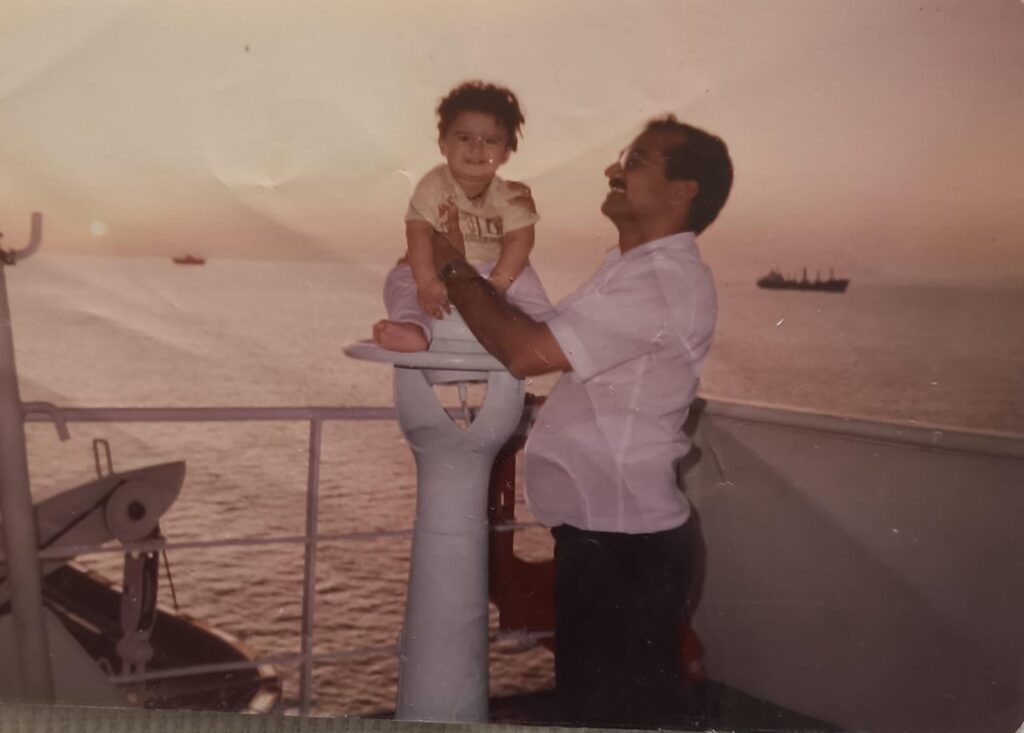
Marriage did not separate my professional and personal worlds; it united them.
Bhanu sailed with me on several voyages, embracing a life that demanded patience, adaptability and extraordinary courage. We signed off together for MV Lavender in Hamburg in January 1990, the only Indians aboard a largely British crew, Bhanu the sole woman on the ship. I later joined the chemical tanker Aditya Vaibhav at Incheon as Chief Officer, trading between Malaysia and the Far East on a vessel that sometimes carried fourteen different grades of oil at once. Bhanu joined me two months later, this time aboard a ship carrying two families, including our Captain’s.
For someone whose world had revolved around music and family, living aboard merchant ships crossing international waters required tremendous adjustment. There were moments of real tension too. During a coconut oil trip to the Philippines, a boat came alongside laden with vegetables and fresh fish, and several women from that boat climbed aboard using the ship’s monkey ladder and disappeared into the crew accommodation. The Captain and I moved quickly to cast off the boat and confirm everyone had returned safely. It was a sharp reminder that even routine voyages carry an edge of unpredictability.
Later, when our son Gaurav joined us as an infant, we experienced one of the most memorable chapters of our lives. He was hoisted aboard by cargo net at Bedi Anchorage in Gujarat at just six months old, ahead of a long voyage to the American West Coast via the Pacific. He grew from a five-month-old baby into an eleven-month-old toddler while travelling across oceans, watching glaciers in Alaska as we loaded newsprint rolls at Ketchikan. His vaccinations were carefully planned in ports thousands of miles from home. Our floating home became his first classroom.
Those months taught me that leadership begins with taking responsibility not only for a ship and its crew, but also for the family that silently shares every sacrifice behind the scenes.
The Weight of Command
Promotion to Master Mariner is often seen as the pinnacle of a seafarer’s career. In reality, it is the beginning of a far greater responsibility. Every voyage places lives, cargo, commercial commitments and the marine environment in the Captain’s hands.
I gradually realised that authority alone never creates leadership. Trust does. A Captain earns respect through competence, fairness, consistency and calmness under pressure. He speaks less and listens more. He accepts responsibility first and seeks recognition last. Those principles remained with me long after I stepped ashore.
The Toughest Decision
After achieving my childhood dream of becoming a Master Mariner, many assumed I would spend the rest of my career at sea. There were emergencies still to answer along the way, ships to be rushed to at short notice, calls from home that once meant signing off mid-voyage to reach Jamshedpur just in time. But India itself was changing. Private ports were emerging, global trade was expanding, and the nation needed people who understood logistics, operations and infrastructure from the ground up.
Leaving the sea was one of the most difficult decisions of my life. Ships had become my home. The bridge had become my workplace. The horizon had become my companion. Yet I believed that the lessons the ocean had taught me could create an even greater impact on land.
A New Ocean Called Infrastructure
My next voyage had no waves. It had blueprints: ports, terminals, supply chains, people.
The oceans had shaped the leader within me. The land would now test that leadership on an even larger canvas. Little did I know that this journey would eventually take me through some of India’s largest port developments and finally to one of the country’s most ambitious infrastructure projects, the Navi Mumbai International Airport.
The ocean had changed. The mission had not.
To be continued…