

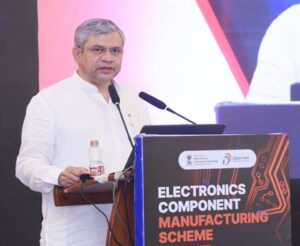


The Electronics Component Manufacturing Scheme is accelerating domestic production of critical electronics components in India.
India’s electronics manufacturing sector has expanded significantly over the past decade, with production rising from ₹1.9 lakh crore in 2014-15 to ₹13.11 lakh crore in 2025-26, and exports growing from over ₹38,000 crore to ₹4.24 lakh crore over the same period. Building on this growth, the government’s next priority is to deepen the ecosystem through domestic component manufacturing, higher value addition and stronger supply-chain resilience.
The Electronics Component Manufacturing Scheme (ECMS) is designed to drive this shift, supporting domestic manufacturing of components, sub-assemblies, supply-chain products and related capital goods that remain heavily import-dependent, including printed circuit boards, camera and display modules, connectors, capacitors, lithium-ion cells and rare-earth magnets. The scheme aims to increase domestic value addition, reduce import dependence and strengthen resilience across India’s electronics supply chain, moving the sector beyond assembly towards manufacturing of critical components and raw materials.
ECMS was notified on April 8, 2025, with an initial outlay of ₹22,919 crore, a six-year tenure and an optional one-year gestation period, with a capital expenditure incentive available for five years. The Union Budget 2026-27 increased the scheme’s outlay to ₹40,000 crore to further deepen domestic component manufacturing. As of August 2026, 106 projects have been approved across 15 states, covering 30 electronic domain products with an approved investment of ₹69,548 crore. Production is already underway at 38 approved plants, while another 16 projects are at advanced stages of construction or machinery installation. The approved projects are expected to generate ₹5.34 lakh crore in production and create 74,628 direct jobs and 2.5 lakh indirect jobs, with domestic production capacity now meeting or exceeding demand across several product categories.
ECMS forms part of a broader set of government initiatives supporting electronics manufacturing. The National Policy on Electronics 2019 set the objective of positioning India as a global hub for Electronics System Design and Manufacturing. The Production Linked Incentive (PLI) Scheme for Large Scale Electronics Manufacturing offers performance-linked incentives of 4 to 6 per cent on incremental sales to scale domestic electronics and mobile manufacturing. The Scheme for Promotion of Manufacturing of Electronic Components and Semiconductors (SPECS) provided a 25 per cent capital expenditure incentive for components, semiconductor and display fabrication, and related units, while the Modified Electronics Manufacturing Clusters scheme (EMC 2.0) supported manufacturing infrastructure and Plug-and-Play capacity.
The PLI for IT Hardware supports domestic manufacturing and investment, with PLI 2.0 building on this to strengthen the ecosystem and reduce import reliance. The Semicon India Programme’s ₹76,000 crore Semicon 1.0 initiative created a broader semiconductor and display manufacturing ecosystem, while Semicon 2.0, approved in July 2026 with a ₹1,27,500 crore outlay, aims to scale India into a global semiconductor hub. Other supporting measures include the Electronics Manufacturing Clusters Scheme, offering financial assistance of up to 50 per cent of project cost for greenfield projects, the Phased Manufacturing Programme for cellular mobile phones and sub-assemblies, and the Electronics Development Fund, which invests in venture funds to support innovation and startup growth in the sector.
As projects under ECMS move from approval to construction and commercial production, the scheme is expected to broaden India’s manufacturing base and strengthen integration with global value chains. India is targeting a $500 billion (₹47.75 lakh crore) domestic electronics manufacturing ecosystem and $150 billion (₹14.33 lakh crore) in electronics exports by 2030.
Source: Press Information Bureau