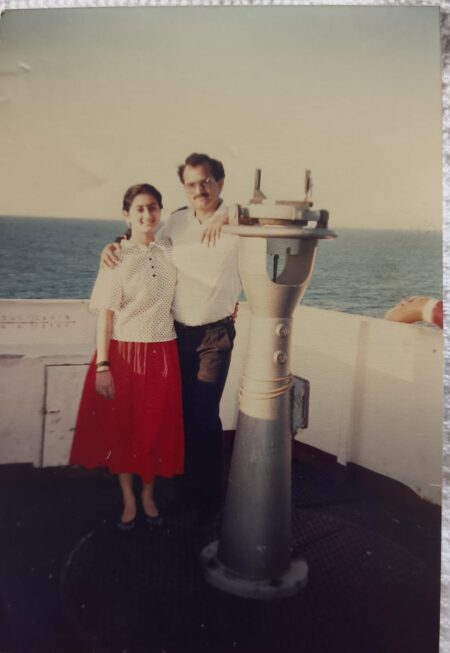



Some careers are built in boardrooms. Capt. BVJK Sharma’s was built on the open sea, in the bilges of a bulk carrier, on storm-battered decks in the Pacific Ocean and in the quiet discipline of a man who refused to let adversity dictate the course of his life.

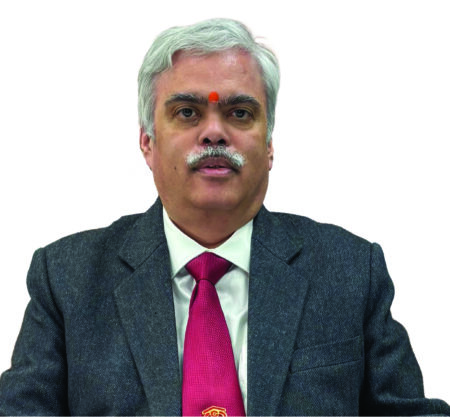
Today, Capt. BVJK Sharma serves as Chief Executive Officer of Navi Mumbai International Airport, one of India’s most strategically significant infrastructure projects. But long before aviation, before leadership titles and national-scale responsibility, there was the sea: unpredictable, unforgiving and transformative.
This is the story of a man who began with very little, survived circumstances that might have broken others and steadily built a life defined by endurance, discipline and purpose.
Beginnings in Jamshedpur
Born and brought up in Jamshedpur, Capt. Sharma grew up in an environment where the sea was not a career anyone spoke about, much less pursued. No one in his family had any connection to maritime life. Yet from an early age, he displayed the qualities that would later define him: academic excellence, quiet leadership and an instinctive ability to persevere. He stood first in school, served as class monitor and kept goal for the school football team. In 1974, he earned admission into R.D. Tata High School on merit and had the rare privilege of participating in school events attended by JRD Tata himself. He passed his matriculation with distinction in 1978 and in 1980 was selected as one of only 22 students from Ranchi University for a B.Sc. Physics Honours programme. Financial realities intervened. Engineering fees were beyond the family’s means and the course had to be left incomplete. For Sharma, it simply meant another route had to be found.
A Boyhood Shaped by Service
Long before the sea taught him resilience, life had already introduced him to discipline and service. In 1969, he joined the RSS Shakha, an early lesson in commitment and community responsibility. Then came the Bangladesh Liberation War of 1971. As refugees, many of them women and children, arrived injured and displaced across Jamshedpur, volunteers worked alongside authorities to provide medical assistance and shelter. Sharma, still in his early teens, was part of those relief efforts. The idea that one must keep working in difficult conditions, that responsibility matters more than comfort, stayed with him long after childhood ended.
The First Encounter With Death
On 31 May 1981, immediately after completing the entrance examination for Training Ship Rajendra in Kolkata, a violent Kal Baisakhi storm broke without warning. Within minutes, torrential rain had turned the streets into waist-deep rivers concealing open storm drains below. Sharma lost his footing and slipped into one, caught instantly in the current. A rickshaw puller battling the same flooded streets saw him disappear, lunged forward and pulled him back to safety. Shaken, Sharma would later reflect on the symbolism: on the day he had taken his first step toward a career at sea, he had also survived his first encounter with death.
The Journey That Almost Wasn’t
In August 1981, Sharma left home to attend a maritime training interview. His elder brother had funded the trip through accumulated savings and his father handed him his long-service wristwatch before he left, everything the family had to give. Travelling toward Hyderabad in an unreserved compartment, disaster struck near Secunderabad station. Men entered the coaches, assaulting passengers and snatching belongings. Sharma was beaten and bruised. His father’s watch was stolen and his bag was damaged, but his suitcase containing documents and demand draft survived. He made the rest of the journey to Mumbai standing in a crowded vestibule, injured and exhausted, without stopping for food, water or medical attention. He arrived, was received by his cousin brother Babji and attended the interview. He was selected and joined Training Ship Rajendra in September 1981.
What the Sea Taught Him
In 1982, Sharma joined the Shipping Corporation of India aboard MV Nalanda, a bulk carrier at Mormugao Port. His first task was clearing oil sludge from the double-bottom bilges. The sea’s introduction was immediate and unsentimental. What followed was a voyage that would stay with him for decades. After loading iron ore from Goa to Japan and proceeding to Vancouver for grain, the passage toward Singapore in December 1982 turned catastrophic. Eight hundred nautical miles off Los Angeles, another ship in the same storm system sank. MV Nalanda began taking water into Hold No. 1 and the grain cargo started swelling, threatening to rupture the hatch covers. The crew tied themselves to the hatch coaming with chains and wire ropes and for three continuous days, with almost no rest and little food, tightened hatch cleats as waves crashed across the deck and the vessel rolled violently. Eventually the creaking stopped. The captain found shelter, the crew returned to accommodation and the cook prepared hot food for men who had spent three days facing the possibility of death. At Singapore anchorage, only the upper layers of grain had bloated. The rest was intact. They had held.
Command, Conflict and the Making of a Captain
The years between 1982 and 1993 would shape Capt. Sharma into a master mariner and eventually lead him to command, a journey marked by relentless hard work, rising responsibility and the realities of global shipping during turbulent times.
Among the defining chapters of those years was sailing during the Iran-Iraq War period in 1986, when merchant shipping operated under constant threat in conflict-affected waters. Commercial vessels faced extraordinary risks and survival depended not only on seamanship but also on judgement, calmness and courage under pressure.
Those years at sea forged a deeper understanding of leadership, the kind built not in theory but in real-world conditions where decisions carried immediate consequences. In 1993, Capt. Sharma achieved what every deck cadet aspires to: command of a ship. It marked the culmination of a journey that had begun over a decade earlier with a damaged suitcase, a scholarship opportunity and an unwavering determination to succeed.
Beyond the Sea
In 1997, Capt. Sharma transitioned ashore, bringing with him the operational discipline and execution mindset forged over decades at sea. What followed was an extraordinary second chapter spanning some of India’s most ambitious industrial and infrastructure developments.
Over the years, he contributed to and led both brownfield and greenfield projects across ports, mining, integrated steel and cement industries, railways, ship design and shipbuilding. His professional journey intersected with the rise of modern private infrastructure in India, including work associated with mega maritime ecosystems such as Mundra Port, projects that helped redefine India’s logistics and industrial landscape.
The same qualities that had once held together a hatch cover in a Pacific storm now found expression in infrastructure creation on land: execution under pressure, systems thinking, operational precision and the ability to lead large-scale transformation.
From Sea Routes to Air Routes
A young man from Jamshedpur who once stood bruised in a train vestibule clutching a damaged suitcase now leads one of the country’s most strategically significant aviation projects. Yet the journey feels less like reinvention and more like continuity.
Because whether at sea, in ports, across industrial corridors or now in aviation infrastructure, leadership ultimately comes down to the same enduring principles: responsibility, discipline, resilience and the ability to remain steady when conditions become difficult.
Capt. BVJK Sharma never really stopped sailing. He simply changed horizons. The storms, the commands, the war-zone sailings, the transition from sea to shore, the creation of ports and industrial ecosystems, and the defining decisions behind some of India’s largest infrastructure journeys: these stories remain for the chapters yet to come.
To be continued…