




Auditability, not payload, defines tomorrow’s aircraft
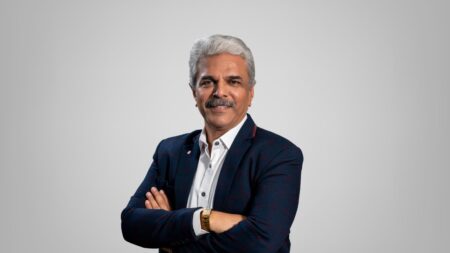
If Mehta is scaling responsiveness into a digital mesh on the ground, Ratandeep Tripathi, Founder, Vjaitra Air Mobility (India & UAE) is engineering it into the airframe itself. For Vjaitra Air Mobility, the technology that has moved decisively from experimentation to operational impact is not artificial intelligence forecasting in isolation, but the combination of IoT enabled tracking with digital twins. A cargo drone such as the company’s CUA-500, built for a five hundred kilogram payload and six hundred kilometre range, only delivers on that promise if every stage of the flight, from battery health to payload integrity to geofence compliance, can be verified in real time. Digital twins allow mission profiles to be simulated before a rotor ever turns, materially shortening ground testing cycles, while predictive maintenance is where forecasting has genuinely moved from the laboratory to daily operations, flagging component fatigue before it can ground an aircraft.
Auditability by Design
Tripathi argues that the demand for transparency has travelled further upstream in aerial logistics than almost anywhere else, reaching all the way into design intent. When Vjaitra architected its AKASH-DRISHTI persistent ISR platform, built for endurance of ten to thirty days, the design brief was not payload alone but auditability, because both defence and industrial customers now expect mission level visibility from the outset. He sees the same principle taking hold in e-commerce logistics, where the expectation of real time proof of location and condition data is pushing resilience and traceability back into airframe and packaging design rather than treating it as a last mile concern.
Decentralising for the Next Decade
On resilience, Tripathi points to geopolitical exposure around critical components and hydrogen infrastructure as the reason Vjaitra has pursued multi sourcing and indigenization from the outset rather than as a contingency measure, with its hydrogen hybrid work alongside partners such as Jio-BP serving as much as a resilience strategy as a sustainability one. Asked how he would redesign distribution for the next decade’s customer, his answer is unambiguous: decentralise everything, replacing large fixed hubs with distributed micro hubs served by autonomous VTOL cargo fleets such as the upcoming VJ-600Max, with manufacturing shifting towards modular, regionally assembled aircraft and the final fifty kilometres becoming drone first by default. The real redesign, in his words, is collapsing the distance between where a product is made, warehoused and delivered, a distance that manufacturers on the ground are working just as hard to close.