



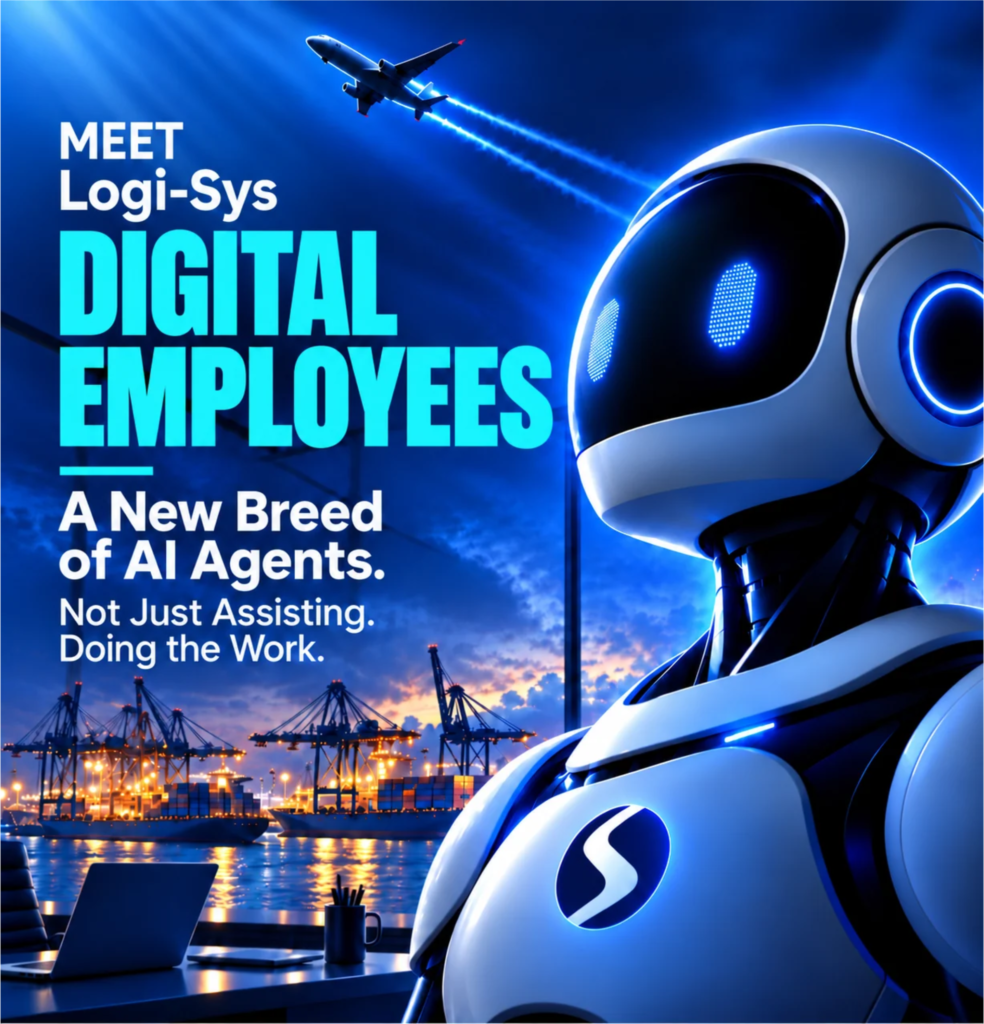
Not Just Assisting. Doing the Work
Freight software has spent decades helping people manage the business. Logi-Sys Digital Employees are being developed for a different assignment: to take on defined operational work within the ERP, with clear limits and people still in control.
The next step is not another screen
It is a familiar scene in a freight forwarding office. An import shipment is approaching arrival. The team must confirm its details, prepare the operational record, check documents, coordinate with partners, respond to the customer and make sure costs and commitments do not get lost along the way. None of these activities exists on its own. A change in one place can create work somewhere else.
Freight software has made this business far more manageable. Shipments, customer information, documentation, accounting and operational updates can now sit within connected systems. Managers have better visibility. Teams are no longer limited to paper files and disconnected spreadsheets.
Still, much of the work depends on someone starting the next step. People read, check, enter, update, follow up and move tasks from one desk to another. We have digitised the information. We have not eliminated nearly as much of the effort around it.
That is the opportunity behind the Digital Employees being developed for Logi-Sys by Softlink Global.
The name is intentional. A Digital Employee is not simply another chatbot or a feature that makes an existing form faster to fill. It is designed for a defined business role, with specific work to complete, access to the information needed for that job and limits on what it may do without a person.
The ambition is straightforward: move freight software beyond recording and assisting, towards performing parts of the operational work itself. At Softlink, we describe this as the journey from a System of Truth to a System of Action.
Agentic AI is the technology. A job is the point.
Agentic AI is already becoming part of enterprise software. Such systems can use tools, take a series of actions and work towards an assigned goal. The technology is not unique to any one vendor, and calling a product an AI agent does not, by itself, make it useful for freight forwarding.
The harder question is what the agent is employed to do.
A general AI agent may answer questions, organise information or be connected to a set of external tools. A Digital Employee, as Softlink is developing the concept, starts with the operational role: what work needs to be done, what counts as completion, which business rules apply and where human authority begins.
Consider the difference between extracting the consignee’s name from a document and preparing an import shipment in the freight system. The first is an information task. The second may involve identifying the correct customer, checking existing shipment details, applying the appropriate process, preparing records and flagging any conflict that prevents completion. Document reading can support that process, but it is not the whole job.
This distinction matters because freight forwarding is not a collection of independent documents. Each shipment is connected to customers, transport arrangements, milestones, costs, commitments and financial controls. AI becomes more valuable when it can work with that business context, not just read an attachment in isolation.
Meet the first Digital Employees
Softlink’s initial development programme centres on three roles. Each is defined by a business responsibility rather than an AI capability list.
Import Freight Shipment Executive
This role is being designed to support the preparation of import shipment information and the associated operational steps within Logi-Sys. Its intended work includes interpreting available shipment information, checking relevant details, preparing supported transaction data and bringing incomplete or conflicting items to the operations team’s attention.
The important outcome is not how many documents an AI model can read. It is whether the relevant shipment work has been prepared correctly and is ready for the next approved step.
Customs Documentation Executive
Customs work is especially sensitive to errors, exceptions and regulatory responsibility. Softlink’s initial work on this role is focused on Indian customs documentation processes. The intended responsibility is to help prepare relevant information, check completeness and identify items requiring professional review.
This is not a claim that an AI system can replace a licensed customs professional or independently make regulatory decisions. The scope of any customs action must be established and approved for the relevant process and market.
Customer Service Executive
Customers do not judge service only by how quickly someone replies. They want an accurate answer and confidence that the next action will happen. This Digital Employee is being designed to help with routine shipment enquiries by retrieving relevant operational information, preparing updates and escalating matters that require judgment or a customer-specific decision.
Across all three roles, the principle is the same: assign clear work, use the freight platform’s business context and keep a person involved where responsibility requires it.
These roles are part of a staged development programme. Their supported actions, geographic scope and commercial availability will depend on testing and formal product release approval.
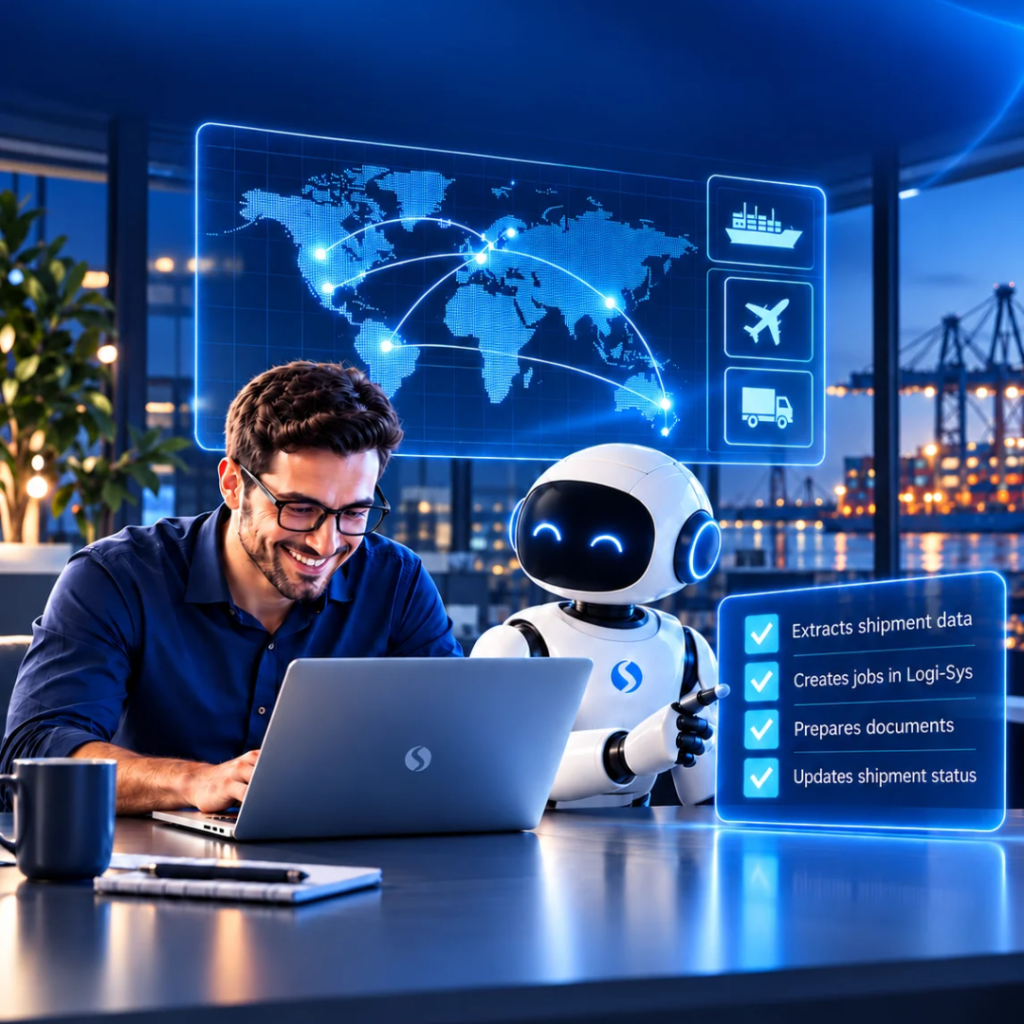
A shipment does not need another chatbot
Imagine an import shipment where the container reference in one source differs from the reference already recorded for the job. An ordinary data-extraction tool may capture both values. An overly confident agent might choose one and proceed.
A properly controlled Digital Employee should instead recognise that the difference matters, stop the affected action and send the exception to the responsible person with enough context to resolve it. It can continue with other authorised work where that is safe.
That example illustrates the intended operating principle; it should not be taken as a claim that every related check is already available in the current product.
The goal is not to make every task autonomous. It is to let the system complete work it can handle reliably, while making the exceptions visible rather than hiding them.
Independence is not the same as authority
There is an understandable excitement around AI systems that can act on their own. But in a freight business, the most interesting question is often not whether an agent can perform an action. It is whether the agent should be allowed to perform it.
Can it prepare a shipment record? Can it alter a delivery commitment? Can it approve an unexpected charge? Can it submit information that creates a legal obligation? These are very different kinds of authority, even if the software is technically capable of calling the same system functions.
No freight company would appoint a new employee and give that person unrestricted access to operations, finance and customer commitments on the first day. A job description, approval limits and reporting lines are basic management tools. Digital work needs the same discipline.
For Digital Employees, that means defined identities and permissions, permitted actions, approval points, a traceable record of activity and a clear route for escalation. It also means the ability to pause or stop work when a serious problem is found. Those controls must be demonstrated for the actual role and deployment; a marketing promise is not enough.
People remain accountable for business decisions. That is not a weakness in the idea. It is what makes the idea suitable for serious enterprise operations.
The business case must be measured in completed work
There is a temptation to measure AI through the number of documents processed, prompts answered or actions performed. Those numbers may be useful for technical teams, but they do not tell a freight CEO whether a deployment is improving the business.
A better starting point is a specific operational assignment. How long does it take today? How much human effort does it use? How often does the information need correction? Where do delays and rework occur?
Then measure the same process with a Digital Employee: transactions completed correctly, time spent on review, exceptions raised, rework required, cost per successfully completed transaction and the effect on customer response or shipment throughput.
A successful result may mean that a small forwarding company can handle more activity without increasing administration at the same pace. For a growing regional operator, it may mean more consistent processing across branches. For a larger group, it may mean better visibility over where work is done, reviewed and approved.
None of these outcomes should be assumed. They need to be established through live operations and measured against a clear baseline.
A five-minute demonstration shows possibility. Several weeks of controlled use begin to show reliability. Sustained use is what establishes whether the economics hold.
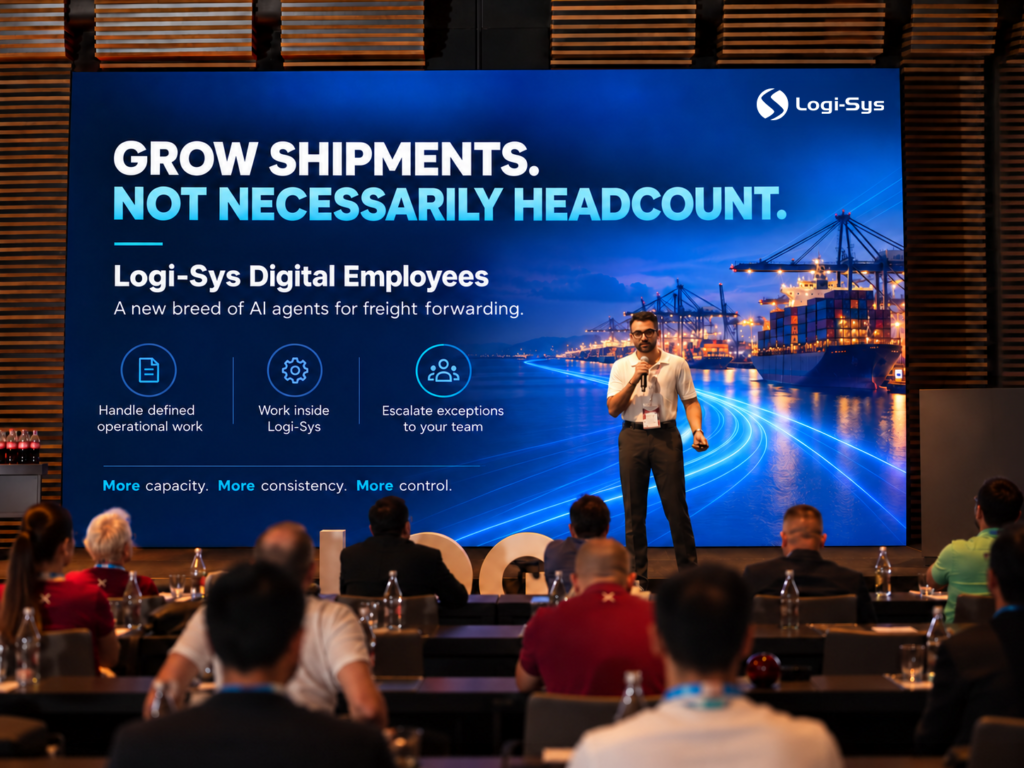
A freight forwarder sees the growth opportunity
The possibility of growing without increasing overheads at the same rate came up at LogX 2026, a freight network conference held in Khao Lak, Thailand. Kunal Maheshwari, Chief Growth Officer at Softlink Global, gave a keynote presentation on Digital Employees to 180+ delegates from 45+ countries.
After the presentation, a freight forwarder from the UAE told Kunal that small and mid-sized forwarding companies commonly respond to higher shipment volumes by hiring more people. Growth then creates another cost: larger offices and higher overheads. What interested him about Digital Employees was the possibility of handling more transactions without having to expand staff and premises at the same pace.
“A forwarder from the UAE immediately looked beyond the technology. He saw the possibility of growing shipment volumes without increasing manpower and overheads at the same rate. That is the business problem Digital Employees should help solve.”
The reaction is useful because it comes from a freight forwarder thinking about growth, not from a vendor measuring AI activity. But it is an expression of interest, not a verified saving. The test remains whether real deployments allow forwarders to complete more shipments with acceptable accuracy, clear human control and a lower cost per completed transaction.
Why the underlying ERP matters ?
The promise of Digital Employees is closely tied to the systems in which they work. An AI model alone does not know a customer’s operating procedures, credit conditions, shipment records or the state of a live transaction. That context lives in business software and in the rules the organisation has established.
Logi-Sys brings freight operations and finance into a connected cloud ERP. Softlink is developing Digital Employees within that setting so that assigned work can be related to actual business information and approved processes.
Behind the scenes, shared infrastructure such as Softlink AI Fabric and TradeCHAIN supports AI and system connectivity. These are technology foundations rather than separate products the customer needs to understand before seeing the benefit.
What customers should ultimately experience is simpler: a defined piece of work is assigned, the system performs the authorised steps, and the responsible team sees the result and any items needing attention.
This also helps explain the difference between deploying Digital Employees within Logi-Sys and using a separate general-purpose agent tool. Both approaches may be valid. The choice should turn on the quality of the integration, the controls available, the effort to maintain the solution and the results it delivers, not the label attached to the AI.
A change in the job of freight professionals
Software performing routine work does not remove the need for experienced freight people. It changes where their attention can go.
A capable import executive does much more than prepare records. They understand the customer, anticipate a problem before it becomes expensive, negotiate with partners and know which exceptions cannot wait. A customer service professional does more than provide a status update. They protect relationships when plans change.
The purpose of a Digital Employee should be to take on work that does not always need those skills, while preserving the points at which judgment, commercial authority and human relationships matter most.
This change will also require managers to think differently. They will need to understand which tasks are assigned to software, what good performance looks like, what checks are in place and when a human must intervene. Managing digital work may become as important as selecting another software module.

From a System of Truth to a System of Action
Softlink Global has spent more than three decades building logistics technology. Logi-Sys serves freight businesses across more than 50 countries. That international experience shapes the problem the company is trying to solve: freight work is connected, time-sensitive and full of exceptions, whether the business has one office or many.
The next phase of freight technology will not be defined by who uses the word ‘agentic’ most often. It will be defined by systems that can carry out useful assignments within clear boundaries, show what they have done and earn the confidence of the people responsible for the business.
For years, the test of a freight ERP was whether it could support a process, store the information and produce the necessary report. Those tests remain important. A new test is arriving alongside them: what portion of the work can the platform perform correctly, under control, at an acceptable cost?
Logi-Sys Digital Employees are Softlink’s answer in development to that question.
They are not meant to be AI agents running loose through an operation. They are intended to have jobs, responsibilities and limits.
The future of freight software is not just knowing what happened. It is being able to do the next piece of work, and knowing when a person must take over.