




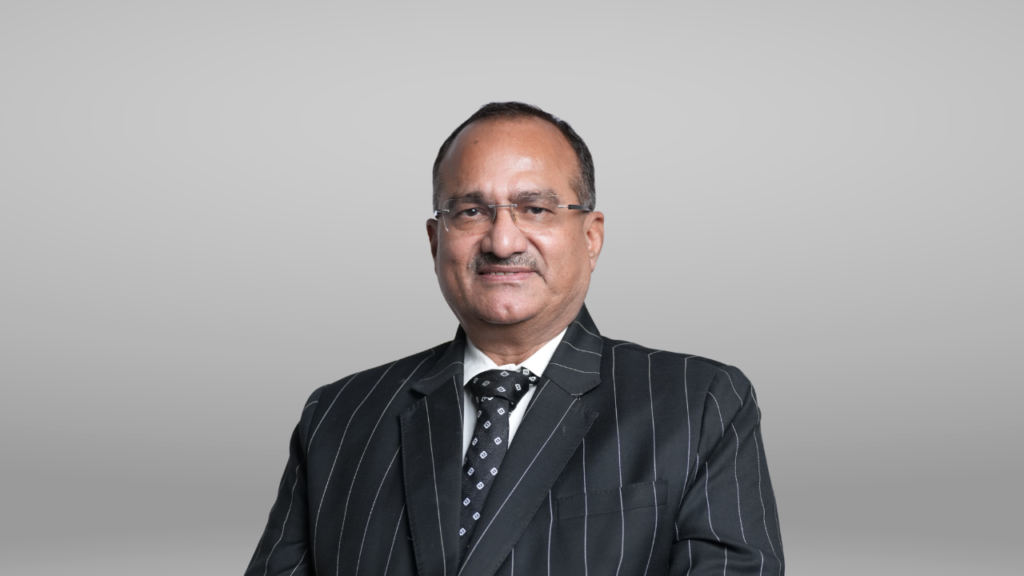
Capt. BVJK Sharma recounts the transformation of a challenging landscape into Mumbai’s second aviation gateway, the concluding chapter of his infrastructure journey.
An airport is usually introduced by its terminal and runway, but Navi Mumbai International Airport (NMIA) began with a more fundamental question: how could a site of hills, a river, low-lying ground and occupied villages become a safe, connected airport? The answer required years of coordinated engineering and human effort before the first passenger could pass through a gate. Mumbai needed another aviation gateway. Chhatrapati Shivaji Maharaj International Airport had limited scope for major expansion, while demand across the metropolitan region continued to grow. The City and Industrial Development Corporation of Maharashtra (CIDCO) offered a long-term solution through its greenfield project at Navi Mumbai. However, the 1,160-hectare site presented formidable engineering and rehabilitation challenges.
The Turning Point
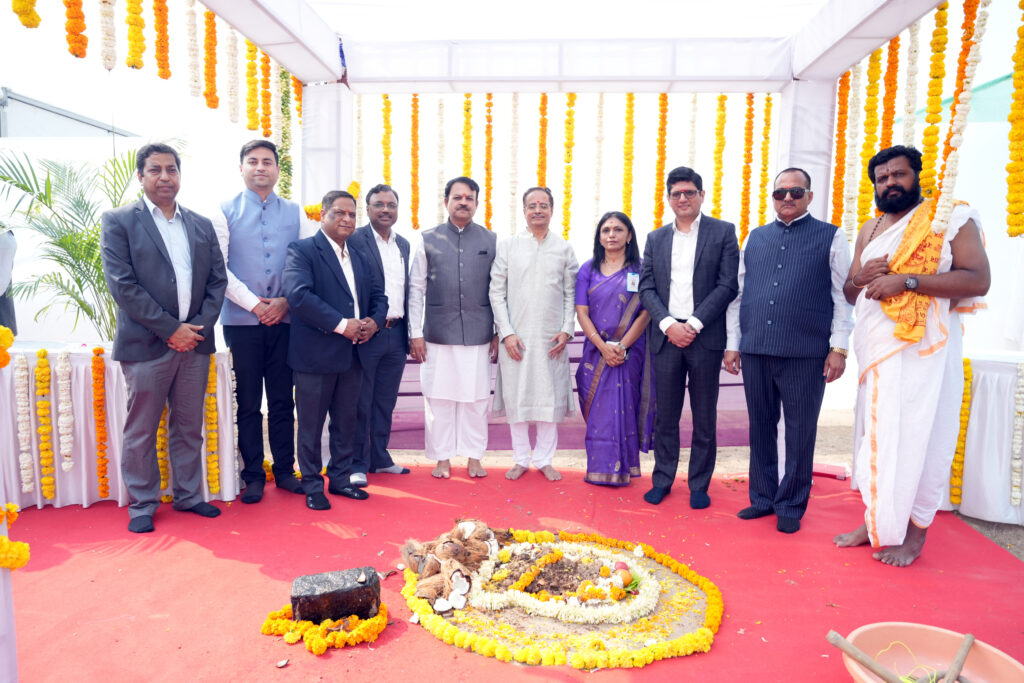
The change of management and the Adani Group’s takeover of the project received formal approval from the Government of Maharashtra on 7 July 2021. Capt. BVJK Sharma joined the project that July, and work began with Bhoomi Poojan on 4 August 2021. Nine villages, home to approximately 3,300 families, lay within the site. The team had to address 45 temples, 92 natural and approximately 894 man-made obstacles to air navigation, as well as water bodies, power lines and a river running through land that was largely hilly and only partly developed.
The project could advance only through close coordination between CIDCO, other public agencies and the concessionaire. Rehabilitation and resettlement, the relocation of community and religious structures, the protection and relocation of plants and animals and the creation of secure site boundaries had to progress alongside the engineering works. None of these tasks could be left until the end. Each determined when construction could safely advance across the land.
Making the Land Buildable
Soon after the 2021 monsoon, rock cutting and blasting began across the site. Material from the hills was used to fill and level the airport land, reducing reliance on externally sourced aggregate and heavy truck movements. The programme also included the Ulwe River diversion channel, ground improvement, retaining structures, drainage, utility relocation and the rerouting of extra-high-voltage power lines. These works created a stable platform, improved flood resilience and cleared the airport approaches before aviation pavements and buildings could be constructed. By September 2022, the last village settlements had vacated, and the project had full possession of the airport land. This decisive milestone allowed the remaining works to be planned and executed as one connected programme.
Approximately 5.5 crore cubic metres of rock were eventually excavated and reused as fill across the 1,160-hectare site. Construction also required substantial quantities of steel, cement, sand, aggregate, glass, aluminium and asphalt by the time Terminal 1 was ready.
The First Operating Platform
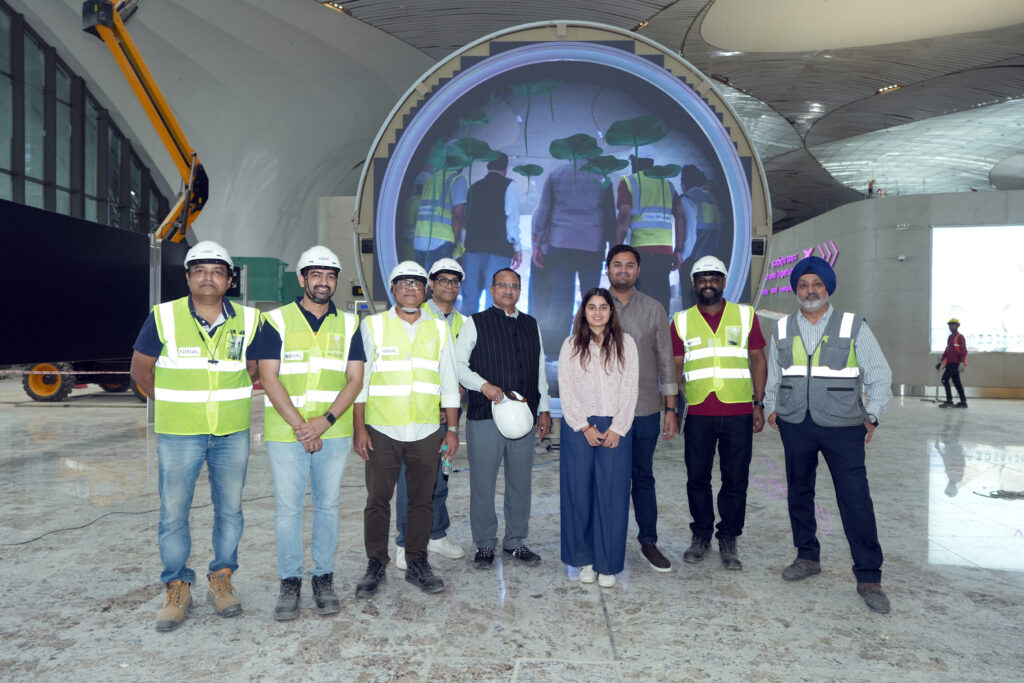
A gateway works only when its many systems work together. Terminal 1, which anchors NMIA’s opening phase, was planned for 20 million passengers a year, with a floor area of approximately 231,000 square metres. Its 3,700-metre southern runway, taxiways, aircraft stands, navigation and lighting systems, aircraft rescue and firefighting services, fuel, power, water, drainage and security must operate as one system. The terminal plan includes 88 check-in counters, including 22 self-service bag drops, 29 contact stands and 13 open stands. Commissioning extended beyond the terminal doors: testing, regulatory clearances, staff readiness and the transition from construction to live operations had to converge before partial domestic commercial operations could begin on 25 December 2025, followed by full-scale operations by 29 March 2026.
The Passenger Journey
The lotus-inspired terminal design by Zaha Hadid Architects combines a strong architectural identity with practical passenger flows, using self-check-in, DigiYatra-enabled gates, automated baggage systems and clear wayfinding to reduce friction throughout the journey. The public spaces express the region itself, from the Bombay Bond dining concept and the NaviVerse cultural zone to the Navi Gate digital art programme, whose installations are built to make a vast terminal feel rooted in place rather than merely impressive in scale. Women-driven pink cabs and the inclusive Mitti Cafe extend that same philosophy into the arrival forecourt.
Connecting the Region
The Mumbai Trans-Harbour Link and dedicated airport roads already improve access to the emerging gateway, and the master plan looks considerably further ahead, to expressways, metro lines, suburban rail, a proposed Mumbai-Hyderabad high-speed rail link and water transport. These connections are at different stages of planning and delivery. Internally, the long-term concept includes automated people movers across four passenger terminals, with passenger, cargo and general aviation access routes all designed to remain clear and efficient as each new phase opens.
A Freight System
For Cargo Insights readers, the freight gateway is central to the NMIA story. The opening programme provides an integrated cargo facility on the eastern side of the airport with direct road access to NH 548. Truck docking and circulation, screening, handling equipment and dedicated working space for Customs, quarantine, airlines, freight forwarders and agents are all built into the service, because a shipment can gain hours in the air and lose every one of them on the ground if apron access, warehouses, security and truck circulation are not designed to expand together from the current capacity of 0.5 million metric tonnes per annum (MMTPA) to 2.0 MMTPA in the next phase and to approximately 3.25 MMTPA in the final phase.
The opportunity is substantial: a second air gateway sitting close to the metropolitan region’s manufacturing and consumption base, its established ports and logistics networks and western India’s wider export and import markets. Winning that traffic will depend on airline connectivity, competitive cargo handling charges, dependable road access, coordinated clearances and transparent service standards, which means cargo has to be managed as a single end-to-end operating ecosystem rather than a series of separate handoffs.
Planning Beyond Phase One
Opening the airport establishes the base for a much larger, carefully phased enterprise. The master plan outlines four interconnected passenger terminals, two 3,700-metre runways, five cargo terminals, a general aviation precinct for approximately 95 aircraft and an ultimate annual passenger capacity of 90 million. The final programme and the necessary approvals are being progressed. The master plan estimates direct and indirect employment of more than 100,000 by the final phase and sets out sustainability ambitions including 39 megawatts of planned solar power, 92 per cent wastewater recycling and 350 hectares of green space. These forecasts express real ambition, but their delivery will depend on phased investment and actual demand.
Future terminal and airfield capacity must be added without ever interrupting the live airport, with each investment following traffic, financing, statutory requirements and the operational lessons of the first phase. Reserving corridors for taxiways, utilities and people movers today is what makes that later expansion feasible at all.
What This Journey Teaches
First, enabling works are the project, not a preface to it. Second, airport capacity is a chain, one in which runway, taxiways, gates, cargo, fuel, staffing and surface access must all advance together rather than in sequence. Third, a first phase only creates real options for the future when it protects space and flexibility for the phases that follow it.
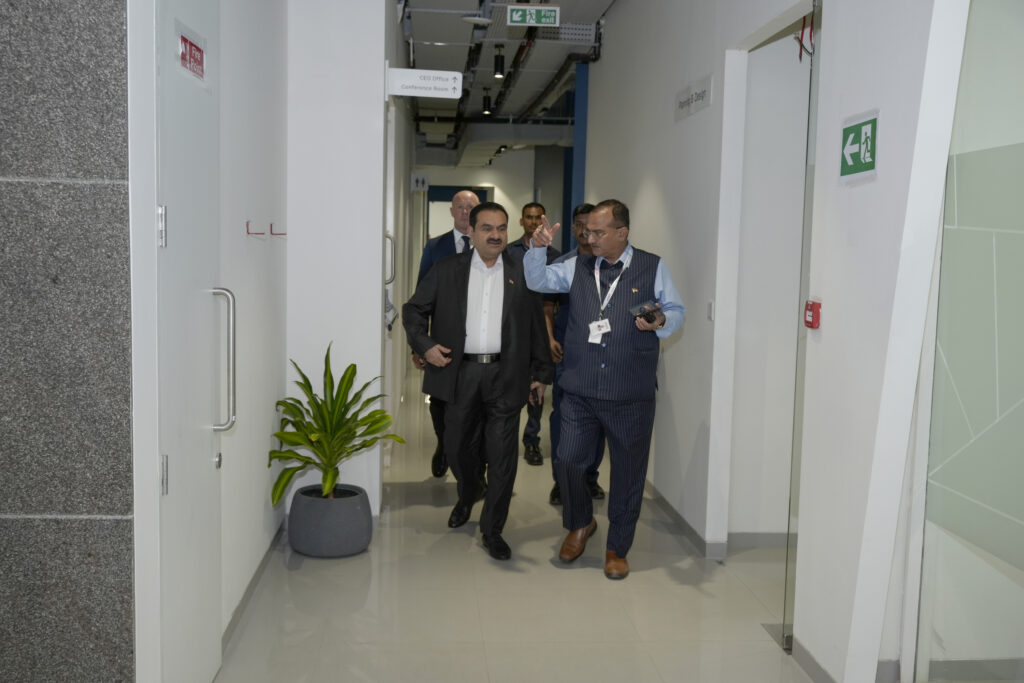
“The journey since July 2021 has been a lesson in collective execution. Communities moved, agencies enabled the work and teams solved a difficult problem in the field almost every day. Their contribution is inseparable from the airport passengers see today.” Capt. BVJK Sharma, CEO, NMIA.
The Captain Who Never Stopped Sailing
Capt. BVJK Sharma concludes this account of NMIA with his attention firmly on the work ahead, a fitting close to a series tracing his journey across five instalments. Readers will recognise the same instincts that shaped every chapter before it: the cyclone that taught him nature must be understood rather than fought, the earthquake that taught him even total loss can be rebuilt and four ports, Mundra, Goa, Jaigarh and Dharamtar, each of which taught him that the hardest infrastructure to build is rarely the part anyone photographs. The ships became ports. The ports became a gateway. Wherever Capt. BVJK Sharma’s career goes from here, this series closes with the same line it opened with: the captain has never really left the bridge.
From 1 November 2026, Capt. BVJK Sharma begins a new chapter, focusing on strategic advisory, distressed asset turnaround and selective board positions. It is a fitting next step for a career spent turning difficult ground, whether coastal, financial or operational, into something that works.