


On a good day it covered 20 km. On a hard one, 10. Yet a single trailer carrying a reactor from Belgium stopped crowds, traffic and highway bridges across four states, all for the machine at the heart of a ₹3,080 crore bet on plastic made from sugarcane.
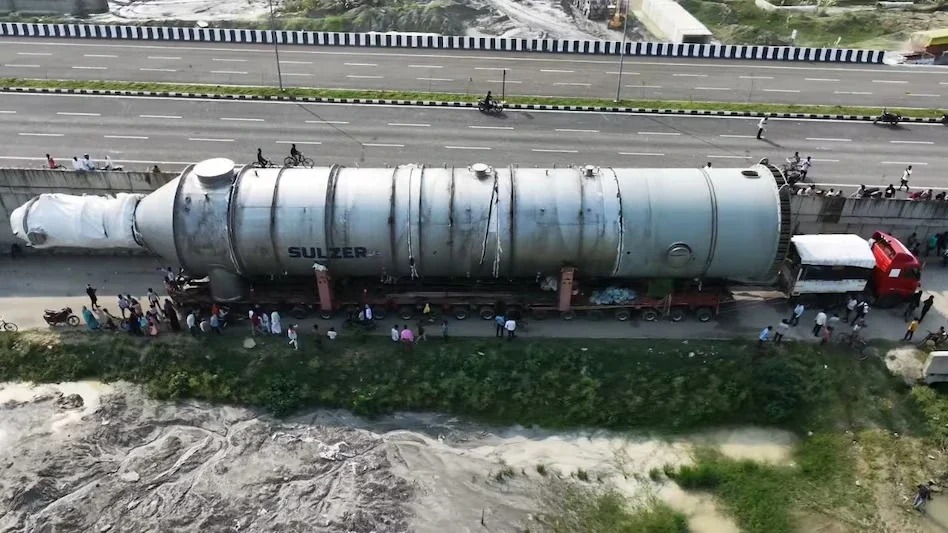
On most days it covered no more than 20 km, and it still became one of the most watched vehicles in India. The trailer set out from Paradip port in Odisha on 308 wheels, crossed Jharkhand and Bihar, entered Uttar Pradesh and, by the night of 20 October, had reached Lakhimpur Kheri district. Along the way, crowds gathered at toll plazas and village crossings to photograph it and film reels. A marine engineer from a nearby village summed up the mood: he had seen larger cargo at sea, he said, but never seen a machine like this carried by road.
On the trailer sat a reactor made in Belgium, about 41 metres long and, by most counts, about 200 tonnes. Its destination was Kumbhi, where Balrampur Chini Mills, a company better known for sugar than for chemistry, is building India’s first industrial-scale plant for polylactic acid, or PLA, a plastic made from plants. The numbers behind that plant explain why one machine was worth three months on the road.
| ₹3,080 crore: cost of the project | 80,000 tonnes of PLA bioplastic a year | ~200tonnes: reactor weight, per most reports | 308 wheels on the trailer at the start | 10-20km covered a day on the road |
A Civil Works Project on Wheels
Moving the reactor was less like shipping and more like construction. Four months of permits and paperwork came before the first kilometre, and teams travelled ahead of the trailer to clear its path. When the convoy reached Chandauli, the road ahead was too low and too narrow for the load, so the logistics team built a temporary section of road to get it onto the ring road. It was stuck there for about two days.
Poles were taken down and trees were cut as it went. Around Varanasi, sections of foot overbridges were opened up to let it pass, and soil was laid on one crossing to spread the weight. Toll plazas made special arrangements, and the police and NHAI inspected the route and managed the crowds. Two cranes and two extra trailers travelled with the convoy for the moments when the main trailer could not manage alone.
The trailer itself kept changing. It left Paradip with 308 wheels, and reports say some were removed to take tight bends, leaving it on 250 to 260. “Wheel counts keep changing,” said one of the project managers on the move.
The Machine and the Men Behind It
The cargo is a cyclization reactor. In a PLA plant, sugar is first turned into lactic acid. The reactor then converts it into lactide, a ring-shaped molecule that is later strung together into the plastic itself. The Swiss engineering group Sulzer supplies the technology for that stage and the ones around it, an agreement announced in March 2024. The reactor was shipped from Belgium in April and spent about a month at sea before it reached Paradip, where a crane lifted it onto the trailer.
Industry reports name J M Baxi Heavy as the company moving it, though we found no public confirmation from J M Baxi or Balrampur. On the road, the logistics manager Anek Bharti said that height and width were the constant obstacles, and that each one was cleared with the relevant departments and authorities before the convoy moved on. Even the reactor’s weight is still debated: most reports say about 200 tonnes, while a few put the reactor itself at 164.
What It Cost
No one has published the full bill for the journey. The only figure in circulation is about ₹2 crore of diesel, reported in late September and not confirmed by the company or the transporter. By our calculation that is roughly 0.06 per cent of the ₹3,080 crore the project is expected to cost, which shows how small the transport bill is next to the investment, even when the journey looks extraordinary.
| Cost item | Figure |
| Total PLA project cost | ₹3,080 crore |
| Earlier project cost | ₹2,850 crore |
| Equity raise proposed alongside | About ₹450 crore |
| Debentures proposed | Up to ₹200 crore |
| Diesel for the road move | About ₹2 crore by 26 September |
Note: Above are estimated figures as per reports and data publicly available
Where It Stands Now
The reactor reached Nakaha on the morning of 21 October, was expected at Kumbhi that night, and installation work has begun. Balrampur had been guiding to an October start for the plant, and one report says production could begin in November. The company has not published a commissioning date.
The plant is meant to make 80,000 tonnes of PLA a year, up from the 75,000 tonnes first announced, from sugarcane, a crop Balrampur already crushes at a scale of 80,000 tonnes a day across ten mills. The company’s Executive Director, Avantika Saraogi, has spoken of peak revenue of about ₹2,000 crore at an EBITDA margin of about 35 per cent. Getting there will not be simple. This is a first-of-its-kind process for India, and bioplastics typically cost more to make than the plastics they replace, so the plant has to prove it can produce at a price the market will pay.
For logistics, the journey was a lesson in what it takes to bring a plant’s most important machine to its site: months of planning, bridges that bend to the cargo and a route that is rebuilt as it is travelled. The reactor has made it. Now the plant has to prove it was worth the wait.
Sources: Amar Ujala (21 October 2026); Aaj Tak (22 October, 5 October, 29 September and 28 September 2026); Dynamite News (26 September 2026); Odisha Bytes (25 September 2026); Indian PSU (30 September 2026); ChiniMandi on the Kumbhi PLA plant; UP Tak (29 September 2026); Deccan Herald (24 October 2026); ITDC India Express on the reactor’s arrival; Balrampur Chini Mills press release (24 April 2026); Sulzer announcement (March 2024); Chemical Industry Digest on revenue and EBITDA guidance; Tribune on the Uttar Pradesh government agreement.