


Anchored by disciplined leadership and global vision, Cargoland International Türkiye and the LogiFEM Society Network are redefining logistics, combining resilient infrastructure, corridor-led strategy, and a business-first women’s ecosystem shaping the future of international trade.
In the high-stakes theatre of global trade, the script has undergone a fundamental rewrite. The era of “just-in-time” efficiency, once defined by low costs and predictable routes, has been replaced by an era of “just-in-case” resilience. Today’s supply chains are battling a perfect storm of geopolitical realignments, climate volatility, and a digital acceleration that moves faster than the hardware it powers.
In this landscape, the industry has reached a definitive inflection point. Competitive advantage no longer belongs simply to the biggest or the fastest, but to the most “institutional.” The real stabilisers of international trade are those who think beyond the next shipment, investing instead in corridor-led strategies, deep-tissue partnerships, and long-term structural integrity.
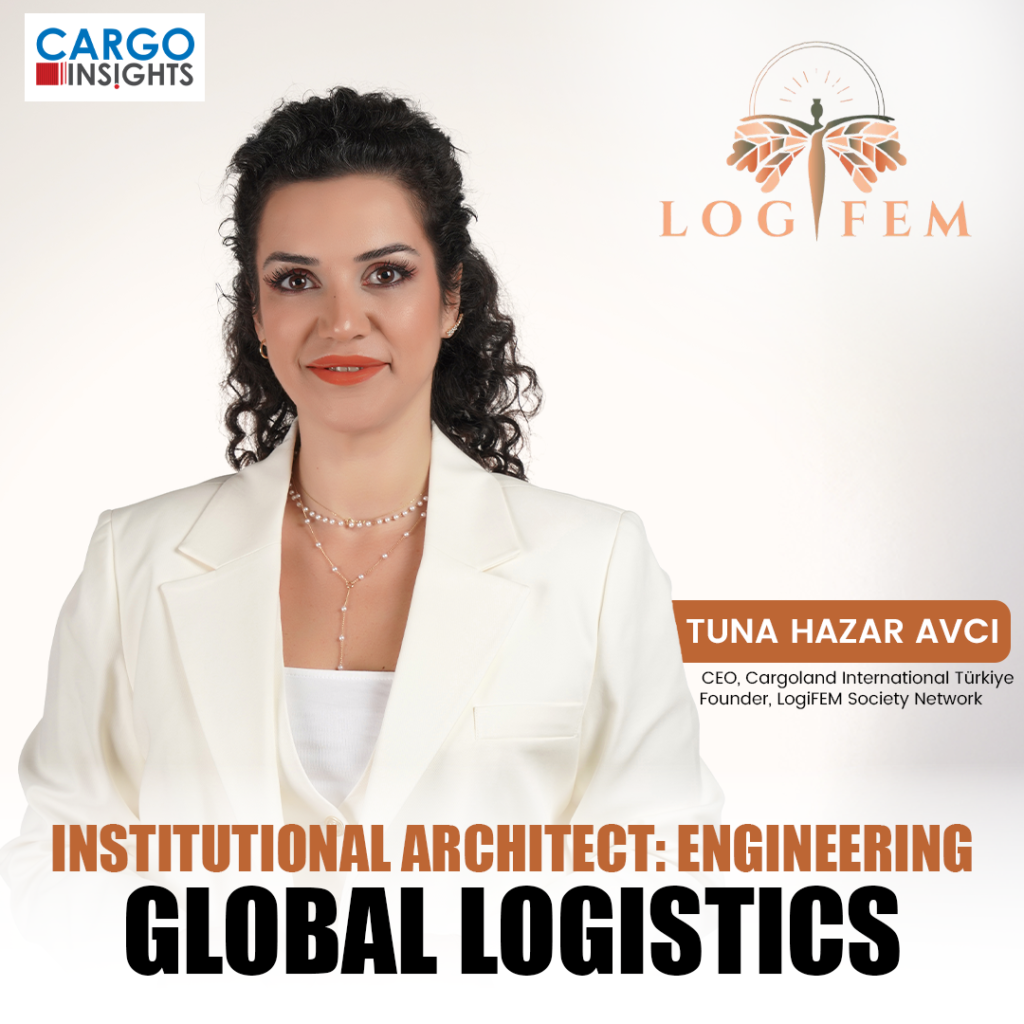
At the centre of this transformation is Tuna Hazar Avcı, CEO, Cargoland International Türkiye and Founder, LogiFEM Society Network. Her approach offers a masterclass in modern leadership: a deliberate shift away from individual visibility toward the creation of systems designed to endure.
“Leadership in logistics is not about being seen,” Avcı asserts. “It is about responsibility, building structures that continue to function long after individual leadership steps aside.”
The maritime blueprint
Avcı’s journey did not begin in a corporate boardroom but in the rigorous world of maritime education. It was here that she learned the fundamentals of global trade, not as a series of spreadsheets but as a discipline where the margin for error is non-existent.
“Maritime education taught me discipline, structure, and the absolute fundamentals of global trade,” Avcı explains. “It taught me resilience, crisis management, and how to stay calm and responsible under pressure.” In the shipping industry, accountability is absolute; a lapse in judgement is measured in tonnes and lives. This foundation directly informs how Cargoland International Türkiye is structured today: decision-making is decentralised but strictly governed, and long-term credibility always takes precedence over opportunistic growth.
When she transitioned into the broader world of global logistics, Avcı brought a realisation that many overlook: supply chains are not merely mechanical systems; they are trust-driven ecosystems. Working across diverse markets helped her understand that logistics is an exercise in integrity. “Logistics is not just about moving cargo,” she notes. “It’s about trust, strong partnerships, and managing complexity with honesty.”
Cargoland: Strategic enablement
Under Avcı’s guidance, Cargoland International Türkiye has been positioned not as a traditional freight forwarder, but as a strategic logistics partner. As the Turkish arm of a Brazil-headquartered global group, the company’s footprint is a map of modern trade priorities: Türkiye, Egypt, Brazil, and Costa Rica.
This is not expansion for the sake of a larger logo. It is a corridor-based operating model. By focusing on lanes where local expertise and multimodal integration intersect, Cargoland creates a buffer against global volatility.
- Türkiye: Acts as the heart of the strategy, a natural bridge between Europe, Asia, and the Middle East.
- Egypt: Provides critical maritime access and North African connectivity.
- Brazil: Anchors the network with industrial depth and South American reach.
- Costa Rica: Adds essential regional flexibility across Central American corridors.
“In today’s world, being a traditional freight forwarder is not enough,” says Avcı. “Our responsibility is to anticipate risk, create flexible solutions, and protect our clients’ competitiveness.”
Operational intelligence as a leadership choice
At Cargoland, digitalisation is not a “support function;” it is a leadership decision. Avcı has positioned data visibility, proactive communication, and operational intelligence as core capabilities. In an industry where disruption is the only constant, the ability to see a bottleneck 48 hours before it happens is a defining advantage.
This intelligence-led framework facilitates:
- Real-time shipment visibility to eliminate “black holes” in the supply chain.
- Proactive risk identification to pivot routes before cargo gets stuck.
- Faster exception management, ensuring recovery is instantaneous when disruptions occur.
Growth, however, remains disciplined. Avcı rejects the “grow at all costs” mentality, believing that unmanaged scale creates fragility. In her view, credibility compounds over time; momentum is fleeting, but trust is an asset that appreciates.
Policy-driven resilience
Building a leadership career in a male-dominated industry required more than mere competence; it required a refusal to be defined by stereotypes. Avcı’s experience in environments with limited female representation strengthened her belief that gender equality is not a soft “HR trend” but a hard business necessity.
“From early on, I learned that results must speak louder than perception,” she says. This philosophy has birthed a leadership style that prioritises execution and performance over hierarchy. By advocating for diversity, Avcı isn’t just checking a box; she is building a healthier corporate culture that makes better decisions because it incorporates more perspectives. Her leadership is guided by three non-negotiable principles: merit over hierarchy, long-term credibility over short-term visibility, and courage in strategic decisions.
LogiFEM: Bridging structural gaps
While building Cargoland’s infrastructure, Avcı identified a glaring systemic imbalance. Women were ubiquitous in the operational trenches of logistics but largely absent from the ownership circles and decision-making platforms.
“The gap was structural,” Avcı observes. “Women were participating but rarely positioned where influence and ownership are exercised.” The issue was never capability; it was access, representation, and structured support for equality.
Her response was the LogiFEM Society Network, the world’s first and largest women-owned logistics network. Designed as a business-focused ecosystem, LogiFEM brings together over 150 verified women freight forwarders worldwide. It is built to support gender equality in a practical way by creating real opportunities and increasing women’s influence in international trade.
Safe ecosystem: Connection to commerce
LogiFEM was intentionally designed as a safe, high-quality, women-only professional ecosystem, not to exclude, but to strengthen. In global logistics, trust drives business. A structured environment built on verification and shared standards turns psychological safety into commercial confidence.
This environment translates into real growth through:
- Curated membership: Only decision-makers are admitted, enabling faster execution.
- Strategic visibility: A platform that generates long-term commercial alliances.
- Focused collaboration: By removing competitive insecurity, members focus on opening new trade lanes and recurring partnerships.
Ultimately, LogiFEM transforms connection into commerce. Avcı’s role is that of the architect, ensuring the platform scales as an independent economic engine that thrives regardless of who is at the helm.
Royal Blue: Networking redefined
The philosophy behind LogiFEM finds its highest expression in its flagship gathering, the LogiFEM Royal Blue Concept networking event, scheduled for June 3–7, 2026, in Marrakech.
Unlike traditional logistics conferences that prioritise scale and generic panels, Royal Blue prioritises quality and outcomes. Participation is curated to ensure strategic relevance. Structured B2B matchmaking replaces the casual collection of business cards.
“Royal Blue is designed to convert connection into collaboration,” Avcı explains. The choice of Marrakech is symbolic, a city at the crossroads of continents, reflecting the network’s core message: women in logistics belong at the strategic centre of global trade. Participants are expected to leave with more than just inspiration; they leave with signed cooperation agreements, defined trade lanes, and long-term strategic alliances.
Leadership infrastructure: Mindset multiplier
Avcı treats self-awareness, personal branding, and confidence not as “soft skills” but as strategic assets. “Self-awareness builds clarity; it allows you to lead proactively rather than reactively,” she notes. “Personal branding builds the credibility that drives opportunity in global trade.”
In a traditionally male-dominated industry, confidence is the multiplier. Without it, competence remains invisible. These dimensions are actively cultivated within the LogiFEM ecosystem, helping women move from operational execution to shaping the industry’s future. By investing in these internal structures, women move from being participants in the trade to being the actors who shape its future.
Luxury of purpose: The setting matters
The June 2026 event in Marrakech is positioned as a luxury, purpose-driven gathering. This is a deliberate choice. Avcı believes that women in logistics deserve an environment that reflects their professional status. A premium setting isn’t just about aesthetics; it’s about signalling value.
From a personal leadership perspective, operating within such an elevated global environment reinforces professional identity. It expands the vision of the participants, encouraging them to see themselves not as local operators, but as global trade actors. When participants return home, they carry with them a transformational mindset that views the global stage as their natural boardroom.
2030: Architecture over participation
As we look toward 2030, the role of women in global logistics will move from participation to real structural influence. Three key forces are accelerating this shift:
- Digital Transformation: It values adaptability and strategic thinking, areas where diverse leadership excels.
- ESG and Sustainability: These priorities demand long-term, responsible leadership, moving away from extractive business models.
- Global Connectivity: Platforms like LogiFEM provide the cross-border impact necessary to influence global policy.
True equality, however, requires deeper changes: board-level representation, access to investment, and merit-based advancement systems. The goal is not symbolic inclusion, but real economic influence. The next decade will see women no longer asking for space but leading within it.
An institutional legacy in motion
Across both Cargoland and LogiFEM, a single theme unites Avcı’s leadership: institution-building. At Cargoland International Türkiye, the goal is to create a resilient, ethical organisation known for its strategic discipline across Europe, the Middle East, and Latin America. Through LogiFEM, the ambition is to build a self-sustaining ecosystem where women hold lasting power.
“True impact is not personal; it is institutional,” Avcı concludes. Legacy is not measured by titles but by the systems that continue to empower others long after the founder steps aside. If, in the coming years, it becomes entirely normal to see women chairing trade associations and managing multinational supply chains, Avcı will consider her mission a success.In an industry defined by movement, these institutions are building something enduring, quietly reshaping the logic of global trade for the decade ahead. Tuna Hazar Avcı is not just moving cargo; she is moving the needle on what it means to lead in the 21st century.