


India chairs the 16th BRICS Trade Ministers’ Meeting on August 7, 2026 in Jaipur, issuing the Jaipur Consensus on MSME trade finance and adopting four annexes covering the multilateral trading system, MSMEs, global value chains and digitally delivered services.
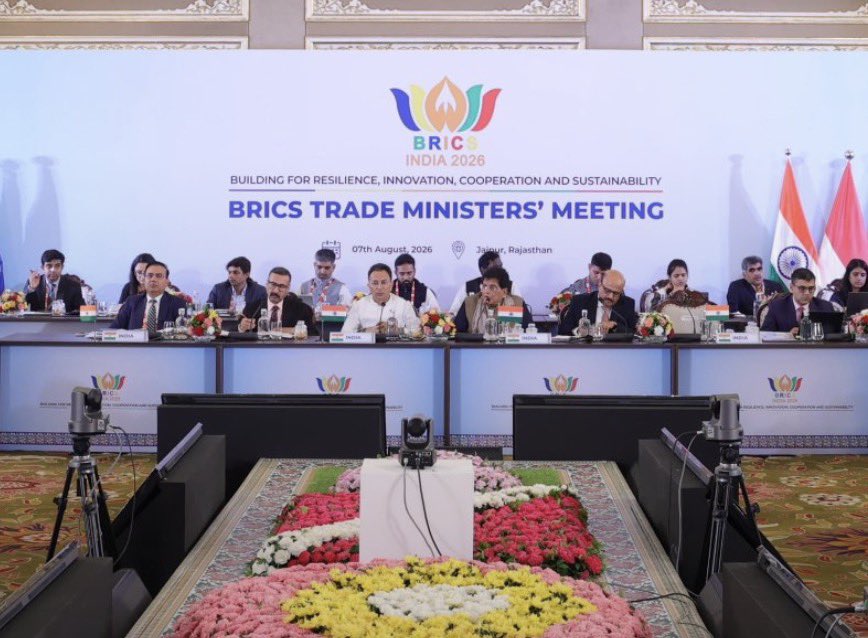
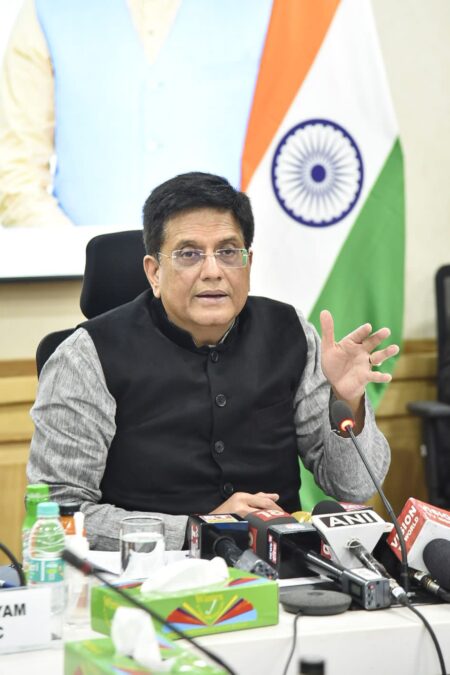
The 16th BRICS Trade Ministers’ Meeting concluded on August 7, 2026 in Jaipur, Rajasthan, under India’s BRICS Chairship 2026, with the theme “Building for Resilience, Innovation, Cooperation and Sustainability.” The meeting was chaired by Piyush Goyal, Union Minister of Commerce and Industry, and attended by Jitin Prasada, Union Minister of State for Commerce and Industry, and Commerce Secretary Rajesh Agrawal.
The meeting was preceded by the Third Meeting of the BRICS Contact Group on Economic and Trade Issues (CGETI), held on August 3 and 4, 2026 in New Delhi. Trade Ministers, Vice Ministers, Heads of Delegation and officials from BRICS member countries attended, including the Minister of State for Development, Industry, Commerce and Services of Brazil, the China International Trade Representative and Vice Minister of Commerce of China, the Minister of Investment and Foreign Trade of Egypt, the Ambassador of Ethiopia, the Minister of Trade of Indonesia, the First Deputy Minister of Trade and Industry of Iran, the Deputy Minister of Economic Development of Russia, the Minister of Trade, Industry and Competition of South Africa and the Minister of Foreign Trade of the UAE.
Goyal set out India’s priorities for the Chairship: strengthening the multilateral trading system; building resilient and diversified global value chains; internationalisation of MSMEs and their access to trade finance; and seamless flow of digitally delivered services across borders. He reaffirmed India’s vision of a reformed, development-oriented, member-driven and consensus-based multilateral trading system with the World Trade Organization at its core, preserving Special and Differential Treatment for developing countries and restoring a fully functioning, two-tier and binding dispute settlement system.
The meeting issued a Chair’s Statement and Outcome Document comprising four annexes. Annex-I affirms the multilateral trading system with the WTO at its core, the preservation of Special and Differential Treatment and the restoration of a fully functioning dispute settlement system, alongside policy space for developing economies for food and livelihood security. On MSMEs, Ministers issued the Jaipur Consensus to study a BRICS Invoice Discounting Mechanism and adopted the Guiding Principles for Credit Assessment Frameworks for Export-Oriented MSMEs, so that a firm is judged by its cash flow and not by its assets and collateral, responding directly to the global trade finance gap of approximately USD 2.5 trillion, both forming part of the Workplan on the Internationalisation of MSMEs adopted as Annex-II.
Annex-III covers the Workplan on the BRICS Shared Understanding on Global Value Chains, including the GVC Action Plan 2026–2030, comprising the BRICS Technical Council, BRICS Connect, a BRICS GVC Joint Study and the possibility of establishing strategic supply chain and investment promotion platforms in the pharmaceutical sector and in food security. Annex-IV adopts the BRICS Principles to Facilitate Digitally Delivered Services Across Borders. Progress was also recorded towards the finalisation of the Strategy for BRICS Economic Partnership 2030, spanning the multilateral trading system, trade in services, the digital economy, industry, innovation and technology, trade and investment, financial cooperation and sustainable development, which Ministers agreed to submit to BRICS Leaders for endorsement.
Source: Press Information Bureau (PIB)