



From India’s first greenfield PPP airport to a globally benchmarked cargo ecosystem, Kempegowda International Airport Bengaluru is redefining speed, reliability, and sustainability, positioning South India as a vital node in next-generation global trade.

ACS delivers real-time visibility across airlines, customs, and freight forwarders
Kempegowda International Airport, Bengaluru, operated by Bangalore International Airport Limited (BIAL), was never meant to be just another airport; it was designed from the outset to redefine what an airport could be. By the late 1990s, Bengaluru’s rapid emergence as a technology and innovation hub had begun to outgrow the city’s existing aviation infrastructure. What followed was not merely an infrastructure project but a reimagining of how India could build and operate critical aviation assets.
Incorporated in 2001 and operationalised in 2008, BLR Airport became India’s first greenfield airport developed under a Public–Private Partnership (PPP) model. That foundational decision shaped everything that followed, forcing commercial discipline, long-term thinking, and global benchmarking into the airport’s DNA. Today, majority-owned by Fairfax India, BLR Airport operates not as a public utility but as a strategic infrastructure enterprise with a sharply defined vision of its role in India’s trade ecosystem.

With over six years of leadership at BIAL and professional experience across global logistics hubs such as Singapore, Hong Kong, and Guangzhou, Fletcher Samuel Sr. Lead, Cargo Business, Bangalore International Airport Ltd (BIAL), has been closely involved in shaping how BLR Airport’s cargo operations have evolved. His role spans infrastructure transformation, concessionaire management across 10 cargo entities, airline partnerships, and digital innovation, placing him at the intersection of strategy and execution. That vantage point allows him to view cargo not as a standalone activity, but as a living system where infrastructure, people, technology, and regulation must move in synchrony, particularly as cargo complexity and velocity increase.
“BLR Airport has evolved from India’s first greenfield PPP airport into one of the country’s leading cargo gateways, now handling over 500,000 metric tonnes annually,” he explains. “Today, BLR Airport’s role extends beyond capacity creation to enabling specialised, resilient, and globally aligned cargo ecosystems that support India’s export ambitions.” This shift reflects a deeper understanding that air cargo performance is increasingly defined by reliability, integration, and time certainty rather than volume alone.
Born from constraint, built with intent
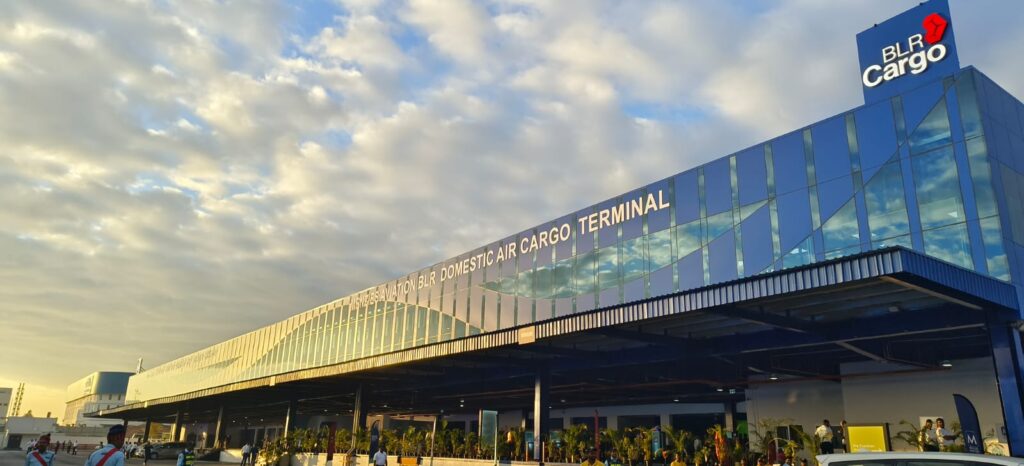
Bangalore International Airport Limited was incorporated in 2001 with a clear and forward-looking purpose: to create an aviation gateway that could grow in step with Bengaluru’s rising influence in global trade, technology, and enterprise. From the very beginning, the vision was not limited to building airport infrastructure, but to shaping an integrated ecosystem that could support long-term mobility, logistics efficiency, and economic expansion for one of India’s most dynamic regions.
When BLR Airport commenced operations in 2008, it marked a significant moment in Indian aviation as the country’s first greenfield airport developed under a Public–Private Partnership (PPP) framework. This model brought with it private-sector discipline, long-term accountability, and global operational benchmarks, elements that became deeply embedded in the airport’s culture. Over time, these principles would influence how cargo infrastructure was planned, how concessionaires were engaged, and how processes and partnerships were structured across the ecosystem.
As the ownership structure evolved and Fairfax India emerged as the dominant shareholder, BLR Airport transitioned from an infrastructure-focused development phase into a financially resilient, professionally managed enterprise with a sharper strategic orientation. Crucially, cargo began to be viewed not as a support service but as a powerful economic enabler. As Fletcher emphasises, this shift aligned BLR Airport’s cargo strategy with India’s manufacturing and export ambitions, particularly for high-value and time-sensitive commodities, reinforcing its role as a purpose-built logistics gateway rather than a conventional cargo handling airport.
Export growth from Bengaluru is strongest toward North America, Europe, and South America, while imports from Asia and the Middle East continue to expand rapidly. To support these evolving trade lanes, BLR Airport has invested in purpose-built cargo infrastructure, including temperature-controlled zones for pharmaceuticals and perishables, high-speed material handling systems, and dedicated express cargo facilities.
“People often see airports as transit points,” Fletcher observes, “but cargo demands something more; it demands predictability, precision, and ecosystem alignment.”
In calendar year 2025, BLR Airport handled 520,985 metric tonnes of cargo, registering a five percent year-on-year increase. These volumes are anchored by pharmaceuticals, perishables, electronics, e-commerce, express logistics, and high-value engineering goods, reflecting Bengaluru’s evolution into a manufacturing, life sciences, and innovation hub rather than a pure consumption market.
Rather than pursuing undifferentiated volume growth, BLR Airport has deliberately aligned its operating model, across processes, partnerships, and capacity planning, around these specialised cargo verticals, enabling high-integrity flows that support India’s evolving export landscape while remaining resilient to volatility and disruption.
Infrastructure designed around cargo behaviour
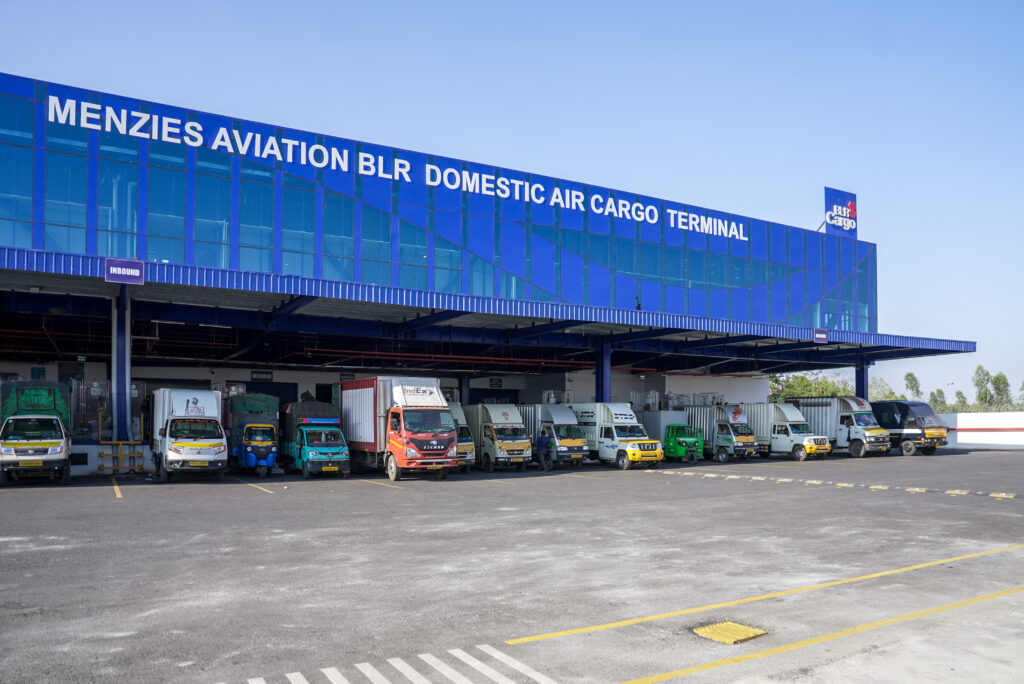
One of the most significant milestones in this journey has been the commissioning of the greenfield Domestic Cargo Terminal operated by Menzies Aviation (MABPL). Designed with integrated X-ray systems, expanded ULD build-up zones, and advanced cargo docks, the facility is pushing domestic handling capacity toward 360,000–400,000 metric tonnes while delivering consistency during peak operational cycles and seasonal demand surges.
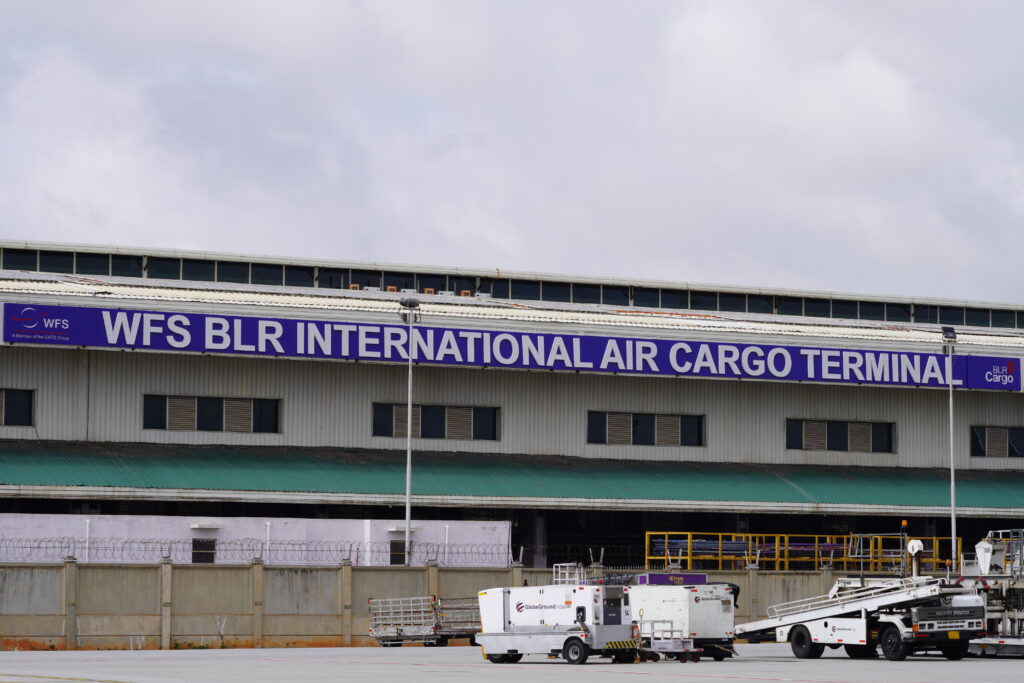
Complementing this is WFS BLR Coolport, India’s first on-airport integrated perishables centre. With an annual capacity of 40,000 MT, soon expanding to 80,000 MT, it offers multi-temperature zones, on-site regulatory clearances, and GDP-compliant handling, significantly reducing dwell time variability for sensitive cargo such as fruits, flowers, vaccines, and life-saving pharmaceuticals.
“Together with CEIV-aligned processes, GDP-compliant handling, cold-chain infrastructure, and ecosystem digitalisation, BLR Airport now operates with an overall cargo handling capacity exceeding one million metric tonnes per year,” Fletcher states.
Engineering zero-lag supply chains
As global supply chains move toward near-zero tolerance for delays, particularly in pharmaceuticals, electronics, and e-commerce, air cargo has become the backbone of time-sensitive trade.
“BLR Airport is reengineering cargo operations around speed, predictability, and precision,” Fletcher explains. “Rather than reactive capacity expansion, the airport has prioritised process optimisation, digital integration, and ecosystem partnerships.”
Strategic collaborations with Menzies Aviation and WFS have strengthened terminal design, cold-chain performance, and operational workflows. On the landside, the Airport Truck Management Facility (ATMF), developed with Shell Mobility, has significantly reduced truck waiting times and enabled just-in-time cargo movement, tightening the interface between road and air logistics and improving schedule adherence across cargo flows.
Truck turnaround time has reduced from nearly four hours to approximately one hour, with 78 percent of trucks processed within 20 minutes, a critical performance gain for perishables, pharmaceuticals, and express cargo.
Digital orchestration at the core
At the centre of this transformation is the Airport Cargo Community System (ACS/CargobyBLR).
“ACS delivers real-time visibility across airlines, customs, and freight forwarders, supporting improved demand forecasting, peak planning, and capacity management,” Fletcher notes.
The platform aggregates real-time and historical data across cargo touchpoints, enabling milestone-level visibility and reducing dependency on manual coordination. Integration with ATMF ensures physical cargo movement aligns with digital readiness, allowing airlines, handlers, forwarders, and customs to operate on a single version of operational truth rather than fragmented data silos.
Export dwell time has reduced to approximately 13 hours, while import dwell time averages 43 hours, reflecting a shift toward predictability and control rather than reactive intervention.
Cargo village as an operating system
BLR Airport’s Cargo Village integrates customs, handlers, trucking partners, and logistics providers into a unified operational ecosystem. Shared dashboards, APIs, and real-time alerts ensure stakeholders operate with a common rhythm, even during demand surges or disruption scenarios.
“This has materially reduced handoff friction, queue build-ups, and decision latency across the cargo chain,” Fletcher explains. Faster truck-to-terminal cycles, tighter cut-off adherence, and predictable build-up windows have improved throughput while enhancing workforce planning and asset utilisation across the ecosystem.
For time-critical, high-value, pharmaceutical, and e-commerce cargo, this integrated model has evolved into a structural advantage rather than an operational aspiration.
Leadership in perishables and pharma
BLR Airport today handles close to 30 percent of India’s perishable air exports, while also serving as a major pharmaceutical gateway.
“Sustaining leadership in highly sensitive cargo segments requires a rigorous operating culture,” Fletcher emphasises, “backed by disciplined investment across infrastructure, digitalisation, multimodal connectivity, and sustainability.”
At BLR Airport, this translates into three operating disciplines: temperature integrity, time certainty, and end-to-end visibility, supported by clearly defined service-level benchmarks that are continuously reviewed in collaboration with industry stakeholders.
Compliance embedded into flow
Balancing speed with regulation remains one of air cargo’s most complex challenges.
“BLR Airport balances rapid cargo movement with strict regulatory compliance through a design philosophy that embeds regulation into the flow, rather than layering it on as a checkpoint,” Fletcher explains.
Facilities such as the MABPL terminal and WFS Coolport integrate screening, regulatory clearances, and temperature-controlled handling within contiguous operating environments. CEIV-aligned processes, GDP compliance, training, and audits ensure uniform execution, while digital platforms enable parallel, not sequential, progression of checks.
Future-proofing for next-generation cargo
Looking ahead, BLR Airport is future-proofing its cargo infrastructure through flexible, scalable, and technology-ready design.
The greenfield domestic cargo terminal features modular layouts, higher floor-load capacities, and reconfigurable zones, allowing seamless transitions between general cargo, express shipments, electronics, batteries, and medical devices. Digitally native design, multimodal readiness, and sustainability-first construction ensure long-term compatibility with evolving cargo behaviours and next-generation trade requirements.
Sustainability beyond the terminal
Terminal 2 has positioned BLR Airport as a global benchmark for sustainable airport architecture, and that mindset extends into cargo operations.
The airport operates on 100 percent renewable electricity, has achieved Scope 1 and 2 net-zero emissions, and is recognised as Asia’s first airport with ACI Level 5 Carbon Accreditation. Cargo operations benefit from solar energy, EV-enabled ground handling, IoT monitoring, and paperless logistics enabled by ATMF and ACS/CargobyBLR.
From infrastructure users to ecosystem partners
“Freight forwarders, integrators, and airlines are not just users of infrastructure; they are ecosystem partners,” Fletcher says.
Through structured engagement, shared performance metrics, and co-location initiatives such as the BLR Logistics Park, BLR Airport works closely with airlines and forwarders to enhance service reliability, resilience, and long-term alignment.
Resilience in an uncertain world
From geopolitical disruptions to climate-related risks, uncertainty has become a constant in global supply chains. BLR Airport builds resilience through structural flexibility, real-time visibility, predictive analytics, and integrated landside systems, ensuring operational continuity even under surge conditions and network disruption.
A differentiated global pathway
Does BLR Airport see itself alongside Singapore, Dubai, or Frankfurt?
“The ambition is not symbolic parity but functional equivalence in reliability, speed, and ecosystem maturity,” Fletcher explains.
Anchored in a strong hinterland for electronics, aerospace, life sciences, perishables, and precision engineering, BLR Airport is shaping a next-generation, India-native cargo hub aligned with emerging global trade patterns.
From transit point to orchestration layer
As India moves toward instant demand cycles and high-value manufacturing growth, BLR Airport’s role is evolving. “Airports can no longer function as passive transit points,” Fletcher reflects. “They must actively synchronise factories, farms, forwarders, airlines, and regulators into a single, data-synchronised flow.”
By combining intelligent systems, expanded capacity, and ecosystem alignment, Kempegowda International Airport Bengaluru, is positioning itself as a strategic enabler of just-in-time exports and a critical node in the future of global trade.