


The United States has announced a trade agreement with India that reduces tariffs on Indian goods and removes an additional duty imposed in 2025, while outlining tariff reductions and purchase commitments by India. Although the agreement has been officially announced, detailed legal notifications and implementation schedules are still awaited.
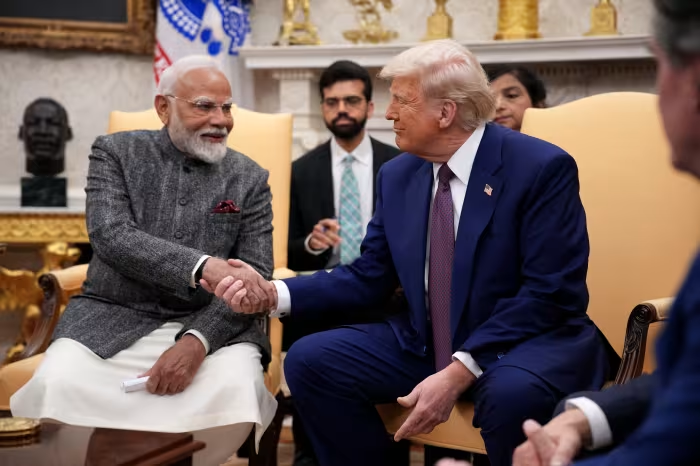
In early February 2026, the United States Government formally announced a trade agreement with India aimed at resetting tariff levels and stabilising bilateral trade relations.
Under the announcement, the United States stated that:
- Tariffs on Indian goods would be reduced to 18 percent, and
- The additional 25 percent tariff imposed in August 2025 would be removed.
These measures are to be implemented through U.S. executive trade actions. At the time of the announcement, product-wise tariff schedules and formal legal notifications had not yet been released.
The agreement follows a period of heightened trade friction between the two countries.
In August 2025, the United States imposed an additional 25 percent duty on imports from India through an executive action. The stated justification for this measure was India’s continued purchase of Russian crude oil, which the U.S. government said conflicted with its sanctions policy framework.
This additional duty was applied on top of existing tariffs, significantly increasing the effective tariff burden on Indian exports to the U.S. market and affecting established trade flows. The tariff escalation led to negotiations that ultimately resulted in the current trade announcement.
According to official statements issued by the Office of the United States Trade Representative, India has agreed to a set of trade-related measures.
These include:
- Lowering tariffs on U.S. industrial goods, described by U.S. officials as being reduced to zero
- Reducing or eliminating import duties on selected items, including:
- Tree nuts
- Fruits and vegetables
- Wine and spirits
At the same time, it has been officially stated that India will retain protections for sensitive agricultural sectors. There has been no announcement of market opening for staple crops or politically sensitive agricultural commodities.
The United States has also stated that India will increase purchases of U.S. goods over multiple years.
The product categories identified include:
- Energy and petroleum products
- Civil aircraft
- Defence equipment
- Pharmaceuticals
U.S. officials have cited a value of up to USD 500 billion over several years for these purchases. No legally binding purchase schedules or enforcement mechanisms have been publicly disclosed.
Energy sourcing remains a key element of the agreement.
The United States government has stated that the trade deal includes India agreeing to halt purchases of Russian oil.
India’s Trade Minister, speaking in Parliament, has stated that India’s priority is energy security and that the country will diversify its energy sources.
As of early February 2026, no official government directive has been issued to Indian refiners instructing them to stop purchasing Russian crude oil.
At present, the India–US trade deal stands as an officially announced political agreement. Several elements are still pending, including:
- Legal texts and executive notifications
- Product-wise tariff schedules
- Implementation timelines
Until these steps are completed, the practical impact on trade volumes and cargo flows will depend on how the announced measures are executed.
Conclusion
The India–US trade deal represents a significant reset in bilateral trade relations following tariff escalation in 2025. While headline measures have been officially announced by the United States and acknowledged by India, the agreement remains in a transitional phase.
For trade, cargo, and logistics stakeholders, the decisive factor will be the release of formal notifications that convert political announcements into operational trade and supply-chain changes.