


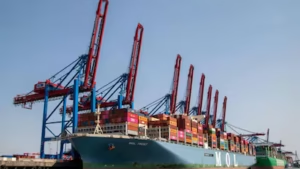


Global trade is evolving. Rajesh Menon, Industry Expert explains why global sync, air cargo resilience, and digital infrastructure are critical for future-ready supply chains.

Global Sync creates an interconnected trade architecture built on time and resilience
After years of disruption driven by geopolitics, supply chain fragmentation, and pandemic aftershocks, 2026 marks a cautious inflection point for global trade. While geopolitical threats still loom large, a growing consensus, particularly across the Global South and India’s trade ecosystem, recognises the need for an interconnected architecture of global trade. This global sync is essential not only to reflect on past disruptions but also to build supply chain resilience for future global trade.
Shifting commodity realities
This transformation is especially relevant for high-value, low-volume commodities such as advanced textiles, specialised chemicals, jewellery, precision engineering tools, and pharmaceuticals. Recent tariff upsurges by US regulators have disproportionately impacted these sectors. In such commodities, maritime dependency is becoming counterproductive, as delivery time increasingly outweighs delivery cost. Here, air cargo emerges as the backbone of resilience, enabling firms to bypass maritime chokepoints, reduce inventory risks, meet stringent timelines, and outpace commodities moving by seaways at reduced cost.
Digital infrastructure as foundation
Four structural drivers are critical to this resilient architecture. The first is building modern digital trade infrastructure. Trade facilitation platforms, electronic air waybills (e-AWB), real-time cargo visibility, and interoperable customs systems, promoted under the WTO Trade Facilitation Agreement, are essential for reducing transaction friction. The convergence of logistics data with enterprise systems enables firms to synchronise production, shipment, and delivery with greater precision.
Airport-centric cargo ecosystems
The second driver is the creation of airport-centric cargo ecosystems. Investments in dedicated freighter terminals, cold-chain infrastructure, pharma zones, and express cargo hubs must be expedited so airports evolve into trade nodes rather than mere transit points, strengthening air cargo infrastructure and export competitiveness.
From liberalisation to enablement
The third aspect focuses on proactive, sector-specific trade policies. Governments are no longer relying solely on broad trade agreements. Instead, they are deploying targeted incentives, regulatory fast-tracks, and export promotion schemes for priority sectors such as pharmaceuticals, electronics, and speciality manufacturing, signalling a shift from trade liberalisation toward trade enablement.
Entrepreneurship as a stabiliser
The final driver is building entrepreneurial capacity to fill institutional gaps. Encouraging small and mid-sized exporters to leverage air logistics, fintech solutions, and global digital marketplaces allows them to integrate directly into international value chains. This bottom-up trade dynamism remains one of the most underappreciated stabilisers of global trade today.
Collaboration for resilience
Beyond these drivers, gaps in hinterland connectivity, warehousing infrastructure, skilled logistics manpower, and regulatory harmonisation must be addressed. Simultaneously, artificial intelligence in logistics, through predictive analytics, demand forecasting, risk management, and route optimisation, is becoming indispensable. Future logistics efficiency will be defined not just by cost but by time-sensitive delivery and service standards. Industry, governments, and academia must now work together to build a resilient global trade ecosystem.