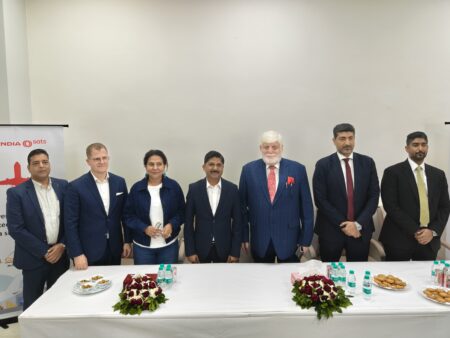





Fletcher Samuel, Senior Lead – Cargo Business at BIAL, reveals how BLR Airport is reimagining resilience, digitisation, and multimodal connectivity to transform South India’s supply chains into a future-ready global gateway.

Resilience, digitisation, and collaboration define BLR Airport’s cargo future
Global logistics has shifted from “just-in-time” to “just-in-case.” Fletcher Samuel believes resilience must be woven into infrastructure from the start. At BLR Airport, this philosophy comes alive in the newly inaugurated Domestic Cargo Terminal, one of India’s largest greenfield cargo facilities. With a design capacity of ~360,000 MT, scalable to ~400,000 MT, the terminal is more than a building; it is South India’s insurance policy against global shocks. Dedicated zones for perishables, live animals, dangerous goods, and valuables ensure that when markets shift suddenly, the airport doesn’t just cope; it thrives.
Turning data into agility
Resilience isn’t only about concrete and steel. It’s also about information. BLR Airport’s Airport Cargo Community System (ACS) connects customs, brokers, shippers, trucking companies, freight forwarders, and airlines on a single digital platform. By cutting paperwork and delays, ACS transforms data into agility. “It’s about making supply chains not just efficient but anti-fragile,” Fletcher explains. Faster, transparent exchanges mean disruptions can be absorbed, not feared.
From tracking to prediction
The integration of CargobyBLR with the national ULIP framework is a leap forward. Instead of merely tracking shipments, partners now gain predictive insights, demand forecasting, capacity planning, and risk scoring. By combining operational data with national logistics intelligence, BLR Airport offers a single source of truth. For shippers and forwarders, this means moving from reaction to anticipation.
Trucks, technology, and tomorrow
Congestion has long been the silent enemy of cargo hubs. BLR Airport’s Truck Management Facility (ATMF) has already proven how structured vehicle flow and live tracking can ease bottlenecks. While AISATS Logistics Park and ATMF are not yet digitally integrated, real-time visibility between ATMF and Cargo Terminal Operators keeps operations smooth. Fletcher sees AI-driven automation at AISATS as the next frontier, a roadmap that will buffer against bottlenecks through 2026 and beyond.
Connecting clusters to corridors
India’s National Logistics Policy and PM Gati Shakti have redefined airports as ecosystems, not nodes. BLR Airport has embraced this vision with Logi Connect, its road feeder service that aggregates cargo from regional production clusters. By reducing transit times and costs, Logi Connect ensures exporters reach global corridors with predictability and speed. It’s multimodal connectivity with a purpose: bridging South India’s factories to the world’s markets.
The 3 pillars of a smart gateway
As India scales its role in global supply chains, BLR Airport is evolving into a global smart gateway. Fletcher outlines three pillars:
- Digitisation: Platforms like CargobyBLR(ACS) drive transparency, speed, and predictive risk management.
- Infrastructure Resilience: Modular, sustainable facilities, solar-powered terminals, and EV-based logistics ensure growth is both scalable and responsible.
- Ecosystem Collaboration: With its strategic location and strong freighter networks, BLR Airport is poised as a natural transshipment hub for South and Southeast Asia.
Together, these pillars transform BLR Airport from a cargo hub into a global connector, future-ready, resilient, and indispensable to India’s trade story.