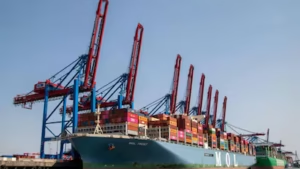


Multimodal logistics is evolving from moving cargo to moving intelligence, synchronising road, rail, air, and sea through AI-driven orchestration. Integrated platforms, predictive routing, and sustainability-led decisions are shaping faster, greener, and more resilient end-to-end supply chains.

Multimodal integration: Moving intelligence across networks
The rise of multimodal logistics is the next frontier, where intelligence drives the orchestration of road, rail, air, and sea networks. Arun Kumar, Immediate Past President, Association Of Multimodal Transport Operators of India (AMTOI), describes this evolution: “Multimodal transport is now preparing to move not just cargo but intelligence across networks. AI, automation, and real-time visibility are enabling road, rail, air, and sea to be synchronised like never before. Predictive routing is replacing reactive planning, dynamic optimisation overtakes static scheduling, and integrated visibility takes precedence over fragmented updates.”
Kumar stresses the need for policy and collaboration to fully realise multimodal potential: “Operators must invest in digital control towers, unified data standards, and interoperable platforms to ensure seamless information flow across stakeholders. AI-driven demand forecasting, automated documentation, and IoT-based condition monitoring dramatically enhance reliability and cut avoidable costs. Green corridors, EV fleets, and modal shift strategies strengthen environmental performance. Digitise, integrate, decarbonise; those who act early will define the smarter, faster, greener logistics ecosystem of 2026 and beyond.”
Multimodal intelligence allows cargo operators to dynamically adjust transport modes based on real-time conditions, service levels, and environmental priorities. Predictive models now consider not only cost and speed but also carbon footprints and regulatory requirements. In India, where infrastructure and modal connectivity are rapidly evolving, this integration promises a step change in efficiency, resilience, and competitiveness.
Digitise, integrate, decarbonise; those who act early will define
Orchestrating end-to-end logistics

Integrated logistics networks are now the operational reality. Biju Thomas, MD, SevenSeas Global, explains, “Logistics networks are increasingly designed as integrated multimodal systems where road, rail, sea, and air are orchestrated as a single end-to-end flow rather than isolated legs. Companies blend modes dynamically based on service levels, lane reliability, and carbon constraints. Long-haul freight may move by rail or sea for cost efficiency, then shift to road or air for time-critical delivery.”
He highlights the role of technology in enabling this orchestration: “API-connected transport management systems unify bookings, documents, and milestones. IoT sensors, GPS telematics, and RFID seals provide continuous data on location, condition, and security. Digital twins simulate disruptions and compare routing scenarios. AI-driven control towers consolidate data from ports, terminals, warehouses, and vehicles, delivering a single source of truth for ETA accuracy, dwell time, and inventory in motion.”
On sustainability and resilience, Thomas adds, “Predictive models balance emissions with transit times, steering freight toward greener modes such as electrified rail or short-sea shipping. Scenario forecasting, diversified corridors, autonomous equipment, and decentralised decision-making ensure continuity during disruptions.”
Integrated multimodal systems orchestrate end-to-end flows efficiently