





Global air freight rose 6% in December, yet 2026 growth may stall as US and EU e-commerce curbs impact trade volumes.
Global air cargo demand concluded a volatile 2025 on a high note, with volumes increasing by 6 percent year-on-year in December. However, industry analysts at Xeneta warn that flatlining e-commerce shipments from China are creating significant concern for airlines and forwarders.
Better-than-expected volumes during the final quarter of 2025 helped the industry record a 4 percent total growth in chargeable weight for the year. This resilience was largely driven by shippers opting for the speed and reliability of air freight amidst broader economic uncertainty and maritime disruptions.
While 2025 offered a mix of benefits, higher volumes for service providers and lower rates for shippers in the latter half of the year, the forecast for 2026 is more conservative. Xeneta predicts a modest volume rise of 2 percent to 3 percent.
Niall van de Wouw, Chief Airfreight Officer at Xeneta, suggested that after the resilience of 2025, there may be “a price to pay” in the coming year. He noted that while uncertainty surrounding trade tariffs initially boosted air freight, the market now faces a “fading boost” from ocean freight diversions and stricter e-commerce regulations.
The most significant headwind for 2026 is the cooling e-commerce sector. Data from November 2025 showed that Chinese cross-border e-commerce exports to the US plunged by 52 percent year-on-year, following a similar 51% drop in October 2025. These record declines follow the removal of de minimis tax exemptions by the US government.
Furthermore, new regulations are tightening the landscape:
- China: From October 2025, the State Council introduced mandatory tax reporting for platforms such as Amazon, Temu, and eBay.
- European Union: On 01 July 2026, a fixed customs duty of €3 will be imposed on small parcels valued below €150.
- Global: Japan and Thailand have also signalled new regulatory frameworks beginning in the 2026 fiscal year.
Despite the growth in demand, average global air freight rates fell by 4 percent year-on-year in December 2025 to $2.83 per kg. On major corridors, such as Europe to North America, spot rates saw a sharp 13 percent decline compared to the previous year.
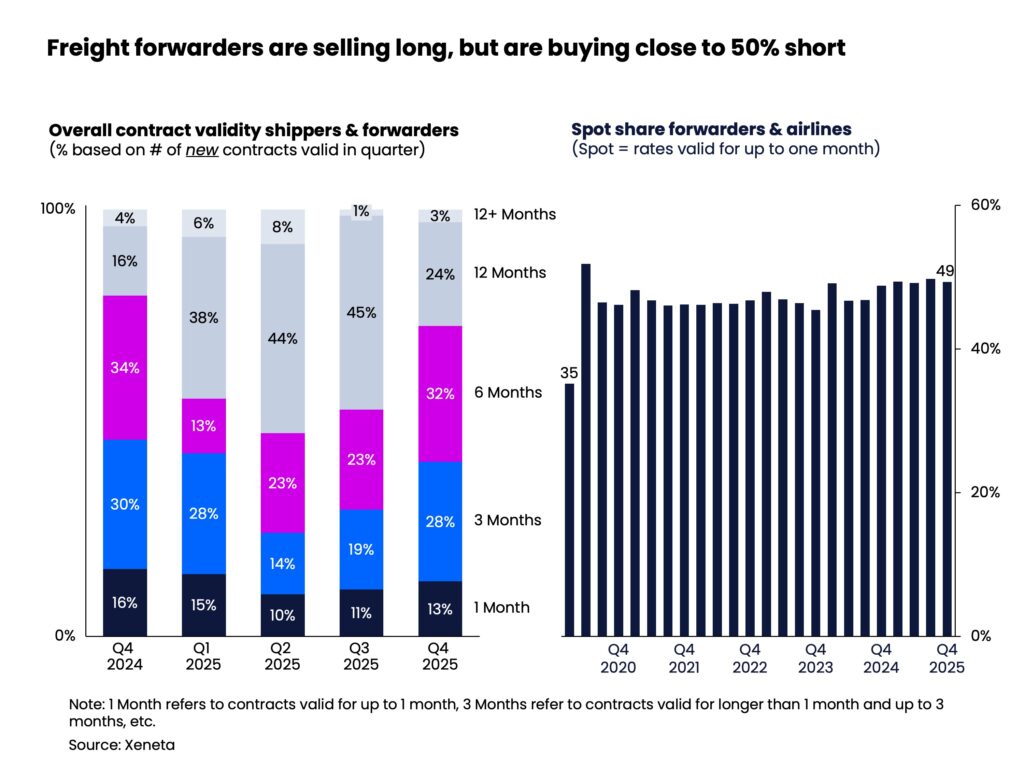
Contracting behaviour also shifted as 2025 ended. One-year contracts accounted for only 24 percent of new deals in the final quarter of 2025, a 20 percent drop from the previous quarter. This indicates that shippers are increasingly wary of locking in long-term rates, betting instead on further price erosion in 2026.
With market fundamentals pointing downwards, the first quarter of 2026 is expected to be a period where shippers seek even lower rates as global demand begins to soften.
SOURCE – PR