


The India International Cargo Show 2026 opened its New Delhi edition at Bharat Mandapam on Wednesday with a ceremony that brought together the senior-most figures in Indian freight, forwarding, and civil aviation policy. Across three days and two halls, IICS 2026 is convening airlines, shipping lines, freight forwarders, 3PLs, technology providers, exporters, and policymakers under one roof.
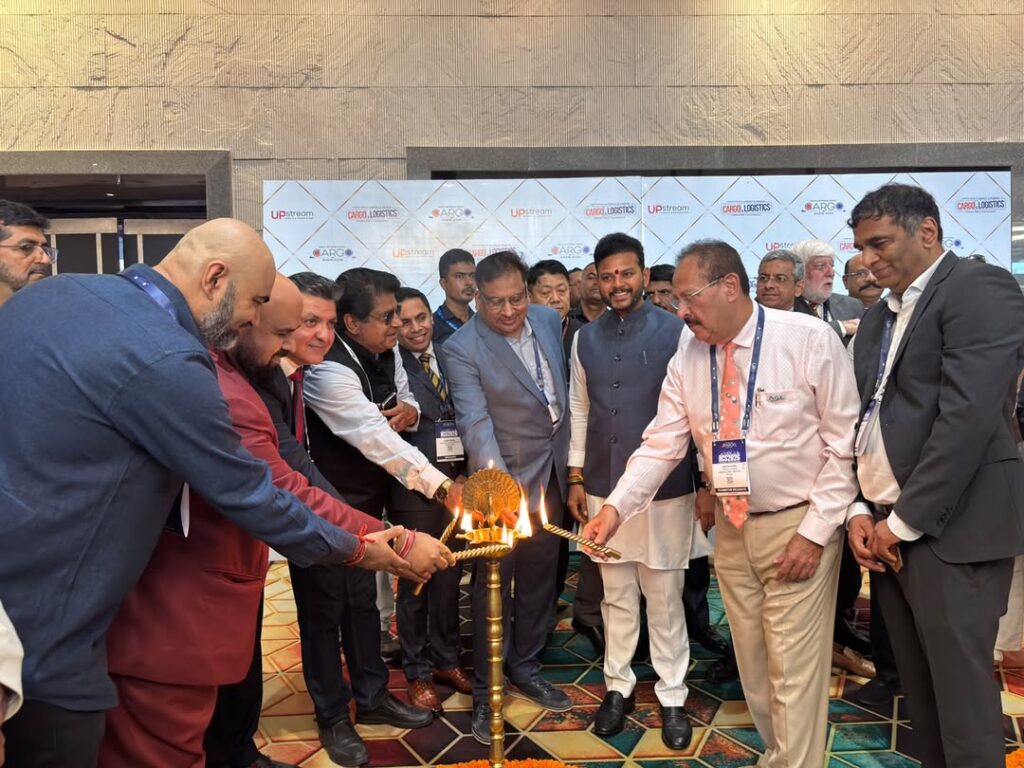
Inaugural Ceremony and Ribbon Cutting
The inauguration of IICS 2026 New Delhi was presided over by Chief Guest Shri Ram Mohan Naidu, Honourable Minister of Civil Aviation, Government of India. As the ceremonial ribbon was cut at Bharat Mandapam, it delivered a direct signal from the highest levels of government that air cargo and trade infrastructure occupy a serious place on India’s national agenda.
Joining the Minister on the dais were Amit Kamat, Chairman, FFFAI; Dushyant Mulani, Immediate Past Chairman, FFFAI; and Samir J. Shah, President, ACAAI, lending institutional weight to the occasion and affirming the industry’s alignment with the policy direction India’s cargo sector is now being asked to follow.
Day 1 Business Sessions
Session 1: Rising Opportunities- Global Air Operators Betting on India
Moderated by: Yashpal Sharma, Chairman and Managing Director, Skyways Group
Panellists: Mark Sutch, Head International Development & CCO Cargo, IndiGo; Rajesh Menon, Regional Head of Cargo – South Asia, Middle East and Africa, Cathay Cargo; Venkatesh Iyer, Vice President-Commercial, Sharaf Cargo India; Hitendra Mankani, Regional Director – MEIA Region, Samsung SDS; Vinod Bhatt, Senior Director & Head of Supply Chain Operations, HP
With India’s air cargo infrastructure expanding and export volumes rising, this session examined what it will take for India to hold its ground as a long-term growth market for global operators. The panel addressed export growth trends, network viability, capacity reliability, and the standard of operational excellence India must meet to compete on the global air freight map.
Session 2: One Nation, One Network- The Dynamic Multimodal Backbone of India’s Export Ecosystem
Moderated by: S. Ramakrishna, Advisor, FFFAI
Panellists: Girija Shanker, Chief Product Officer – Logistics and Services, India / South Asia, Maersk Line; Vinet K. Chadha, Chairman – Northern Region, ACAAI; Sunil K. Vaswani, Container Shipping Lines Association (CSLA), Deepak Sharma, Group CPO & President SCM, Kalpataru Projects International; Dr. Girish Kumar Tuteja, Vice President & Global Head – Logistics, UFLEX Limited; Jay Kumar Patro, Head of Department – Logistics, Plasser India
The Dedicated Freight Corridors are being built, the Multimodal Logistics Parks are coming up, and PM Gati Shakti is in motion. Yet for most exporters, moving cargo from factory gate to foreign port remains fragmented. This session put that contradiction at the centre of the debate, with panellists spanning global shipping lines, freight forwarder associations, infrastructure manufacturers, and large-scale exporters examining the real cost and consequence of the gap.
Session 3: Aligning Air Cargo Networks with the Evolving Needs of Exporters
Moderated by: Keku Bomi Gazder, Managing Director and CEO, Aviapro Logistic Services
Panellists: Vaibhav Vohra, Managing Director, Continental Carriers; Halit Tuncer, VP Cargo Sales MEASA, Turkish Cargo; Kiran Jain, Chief Operating Officer, Noida International Airport; Ramkesh Jangra, Global Inbound Supply Manager, Ericsson Global; Mithileshwar Thakur, Secretary General, Apparel Export Promotion Council
Rate unpredictability, limited capacity windows, and inconsistent service levels formed the core of this operationally grounded conversation. Carrier, infrastructure, and shipper perspectives converged to address the persistent service gaps in Indian air freight, connecting infrastructure readiness with the lived cost pressures of India’s export community.
Session 4: Technology in Logistics- From Option to Necessity
Moderated by: Meheriar Patel, Group Chief Technology Officer and Director of IT, Master Group
Panellists: Kunal Maheshwari, Chief Growth Officer, Softlink Global; Parvinder Singh, Managing Director, Hans Infomatic; Sushant Shetty, Executive Director & Head – Channel Liabilities, DBS Bank India; Pankaj Aggarwal, Chief Operating Officer, Unibuild.ai (Motherson Group); Pavel Mehta, Vice President Supply Chain- India, Pernod Ricard; Dr. Arloph John Vieira, Vice President Supply Chain Bajaj Healthcare.
With real-time tracking, control tower visibility, and digital freight platforms already available, the session asked why consistent adoption remains the missing link across India’s logistics ecosystem. The presence of DBS Bank alongside supply chain leaders from Pernod Ricard, Bajaj Healthcare, and Motherson Group underlined a central finding: technology adoption in logistics is as much a financing and interoperability challenge as it is a product one.Day 2 Business Sessions
Session 1: Strengthening Export Cargo Movement from Inland Terminals to Ports and International Markets
Moderated by: Jitendra Srivastava, Chief Executive Officer, Triton Logistics and Maritime
Panellists: Ravi P. Chaturvedi, Executive Director- Delhi, Container Corporation of India; Kumar Pulkeshin, Head of Rail and Inland Terminals, J M Baxi Group; Sasi Nair, Senior Area General Manager North India, CMA CGM Agencies (India) Pvt. Ltd.; Ravindra Dhing, Chief Supply Chain Officer, Tega Industries; Rajiv Ganju, Sr. Vice President Global Supply Chain, Luminous Power Technologies; Mayur Chhabra, Head of Supply Chain, JK Cement
This session examined one of the most persistent structural challenges in Indian logistics: the gap between inland terminal capacity and seamless port connectivity. Congestion, coordination failures, and inconsistent cargo handling across ICDs, rail networks, and port gateways were identified as the primary drivers of inflated costs and eroding delivery predictability for India’s manufacturing exporters. CONCOR and J M Baxi brought the infrastructure lens, while Tega Industries, Luminous Power Technologies, and JK Cement grounded the debate in real operational consequence.
Session 2: Leveraging 3PL Logistics Networks to Improve Cost and Delivery Performance
Moderated by: Bharat Bhushan Rathi, Head IBP and Supply Chain COE, JK Organisation
Panellists: Ravinder Singh Rathore, Country Manager, UPS SCS India; Ajay Sharma, President -Supply Chain Management, Usha International; Kapil Kapoor, Head SCM, Merino Group; Mahesh Gupta, Head of Supply Chain Management, DS Group;
Kamaljeet Singh, Assistant Vice President, Jakson Solar
The session interrogated what genuine performance accountability looks like from a 3PL partner, and how domestic logistics networks can scale without compromising delivery commitments. Moving beyond capability claims, the panel examined cost structures, network design, and the measurable performance standards that manufacturers and FMCG companies are increasingly demanding from their logistics partners. UPS SCS India represented global 3PL benchmarks, while supply chain heads from Usha International, Merino Group, DS Group, and Jakson Solar brought the unfiltered buyer perspective.
Session 3: Express Logistics in Disrupted Times — Enabling Faster Inventory Replenishment and Agile Distribution for Business Growth
Moderated by: Dipanjan Banerjee, Chief Commercial Officer, Blue Dart
Panellists: Gautam Kapoor, Chief Operating Officer, Shiprocket; Fardeen Malbarwala, Director, Galaxy Freight; Animesh Gupta, Vice President – Procurement, Varun Beverages Ltd.; Bhupendra Kumar, Head of Logistics & Commercial- Flexible Packaging Business, UFLEX Limited; Tejas Mehta, Head Logistics and Marketing Support Services, Reliance Life Sciences; Vikas Goyal, Head of Supply Chain Management, Fortis Healthcare
Disruption, the panel agreed, is no longer the exception but the operating condition. This session examined how express logistics had evolved from a premium service option into a core enabler of supply chain resilience, with voices spanning e-commerce distribution at Shiprocket’s scale to the critical, time-sensitive supply chain demands of Reliance Life Sciences and Fortis Healthcare. Faster replenishment cycles and agile distribution, the session concluded, were no longer aspirational targets but baseline expectations.
Session 4: India’s Warehousing Expansion Delivering Real Supply Chain Efficiency
Moderated by: Akshay Grover, Senior Director, Cushman and Wakefield
Panellists: Rohini Pathi, National Head – Business Development, TVS Industrial & Logistics Parks; Amritpal Singh, Managing Director, Protiviti; Shonik Goyal, President & Head – Supply Chain Management, Sheela Foam; Mohit Jauhari, Head SCM, Shriram Pistons & Rings; Kartik Shah, Regional Manager APAC- Logistics, Sennheiser Electronics; Amit Rai, Head – Warehousing and Transportation, Amway
India has built the warehouses. Grade A facilities have multiplied and 3PL-operated distribution networks have scaled. But this session drew a firm distinction between capacity and performance, placing automation, network integration, utilisation rates, and the 3PL accountability gap at the centre of the debate. The panel reflected the full warehousing value chain, from TVS Industrial and Logistics Parks’ infrastructure perspective to the supply chain demands of Sheela Foam, Shriram Pistons and Rings, Sennheiser, and Amway.
Session 5: WAI Exclusive Knowledge Session — Driving the Future: Logistics Intelligence, Infrastructure Standards, Gender Inclusivity and Workforce Excellence
Guest of Honour: Dr. Surendra Ahirwar, IRTS, Executive Director, Traffic Commercial (Rates), Indian Railways
AI-integrated logistics intelligence: Srinivas KallaKurchi (Optimon), Manu Raj Bhalla (WAI)
Workforce readiness for Logistics 2030, moderated by Mohit Kapoor (WAI) and Keku Bomi Gazder (Aviapro Logistic Services): Dr. Surya Prakash (GLIM), Vijay Parihar (MJ Warehousing), Gopal Mor (ASSOCHAM and WAI Board)
Gender-diverse leadership, moderated by Mitali Nikore (Nikore Associates): Priya Anil Thomas (Thomas Global), Shweta Goela (Safexpress), Anita Juneija (Delhi Customs Brokers Association), Sadhika Kumar (Lynkit)
The Warehousing Association of India’s exclusive two-hour knowledge session was one of the most layered discussions of the conference, threading together predictive AI, future-ready talent frameworks, and gender-inclusive leadership into a single structured conversation. Dr. Surendra Ahirwar of Indian Railways set the policy and infrastructure context, after which the session moved through three focused segments addressing AI-integrated logistics intelligence, workforce readiness for Logistics 2030, and the imperative of gender-diverse leadership. The session made a pointed argument: a logistics sector that does not invest in its people and its inclusivity will struggle to sustain the growth it is building towards.