



The US tariff shock deepens as the EU considers suspending the trade deal after Trump imposes a 15% levy post Supreme Court ruling.
Global trade markets were thrown into fresh uncertainty after the US Supreme Court struck down President Donald Trump’s earlier tariff mechanism, prompting the White House to swiftly impose a revised 15% import duty.
The ruling, delivered in a 6–3 verdict on Friday, held that Trump had acted unlawfully by invoking the International Emergency Economic Powers Act to levy so-called “reciprocal” tariffs ranging from 10% to 50% on multiple trading partners. Within hours, Trump announced a fresh 10% global tariff, followed a day later by an escalation to 15%, calling it the “fully allowed and legally tested” level.
The move has triggered sharp reactions across capitals. The European Union is now considering suspending legislative work on its trade agreement with Washington. Bernd Lange, chair of the European Parliament’s trade committee, described the situation as “pure customs chaos” and said he would propose halting approval of the so-called Turnberry Agreement at an emergency meeting on Monday.
In Canberra, the Australian Government said it would “examine all options” following the imposition of the 15% tariff on imports.
Trump reacted angrily to the court’s decision on his Truth Social platform, accusing the judiciary of undermining US interests and claiming, without evidence, that foreign influence played a role. Speaking to reporters, he said he was “ashamed” of certain justices for lacking the courage to protect the country’s trade agenda.
India Watching Closely
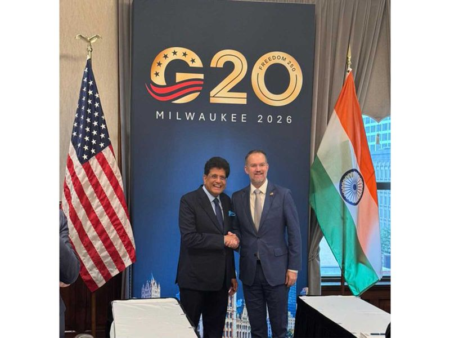
In New Delhi, the Ministry of Commerce and Industry said it is closely studying the developments and their implications for India. Union minister Pralhad Joshi confirmed that the Centre would examine the ruling, with an official response to follow.
Officials familiar with the matter said the proposed 18% reciprocal tariff on Indian goods announced earlier this month may no longer apply following the Supreme Court verdict. For India, the effective reciprocal tariff would now fall from 25% to 15%, instead of the 18% outlined in the February 7 joint statement. Despite the disruption, both sides remain committed to finalising a “mutually beneficial” interim India–US trade deal, taking the changed legal landscape into account.
According to a White House fact sheet, the initial 10% global tariffs are scheduled to take effect from February 24 at 12:01 a.m. Washington time. Trump is also due to address Congress later that evening in his State of the Union speech, where trade is expected to feature prominently.
As governments scramble to reassess their positions, the sudden policy shifts have heightened fears of prolonged uncertainty in global trade flows, with businesses and markets bracing for further volatility.
Source: HT