



At MILAN 2026 in Vizag, Rajnath Singh urges navies from 74 nations to strengthen cooperation and rule-based seas.
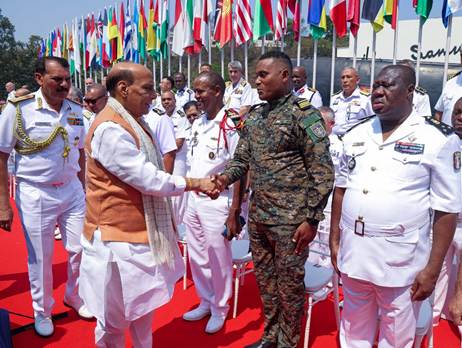
Raksha Mantri Rajnath Singh today called on the global fraternity to unite in addressing evolving and interconnected maritime challenges as he inaugurated Exercise MILAN 2026 at Visakhapatnam. Navy Chiefs and Heads of Delegations from 74 countries are participating in one of the largest and most complex editions of the Indian Navy’s multilateral exercise.
Addressing senior naval leaders, the Raksha Mantri underscored that traditional threats now coexist with emerging challenges such as piracy, maritime terrorism, illegal fishing, trafficking, cyber vulnerabilities, disruptions to critical supply chains, and climate-change-induced disasters. With rising global trade, competition over strategic waterways, and growing attention on underwater resources, including rare-earth minerals, he said no single navy can address these challenges alone, stressing the need for deeper cooperation.
Shri Rajnath Singh highlighted the importance of the UN Convention on the Law of the Sea (UNCLOS) as a robust and time-tested legal framework while calling for a comprehensive global naval architecture to further strengthen information sharing, protect sea lines of communication, and curb criminal and terrorist activities on the high seas.
Noting shifts in the international order, he said platforms like MILAN build trust, enhance interoperability, and enable coordinated responses to common threats. He traced the evolution of India’s maritime outlook from SAGAR (Security and Growth for All in the Region) to MAHASAGAR (Mutual and Holistic Advancement for Security and Growth Across Regions), reflecting India’s deepening engagement with partners across oceans in line with the vision of Narendra Modi. Reiterating India’s role as a trusted Vishwa-Mitra, he affirmed the country’s commitment to constructive and dependable regional leadership.
Describing MILAN 2026 as a testament to global confidence in India, the Raksha Mantri said the exercise seeks to enhance interoperability, professional competence, and friendships among navies, while promoting an equitable, rule-based maritime order and freedom of navigation in accordance with international law. He also cited the International Fleet Review 2026 as an affirmation of shared values and professionalism among the world’s navies.
In his opening remarks, Chief of the Naval Staff Admiral Dinesh K. Tripathi likened MILAN to a “Maritime Mahakumbh,” emphasising that today’s complex, transnational maritime challenges are best addressed through cooperation and partnership. He noted that during MILAN 2026, participating navies will undertake complex manoeuvres, drills, professional exchanges, and discussions to build trust and operational synergy.
MILAN 2026 will be conducted in two phases: a Harbour Phase focused on professional interaction, seminars, exchanges, and cultural engagements, followed by a Sea Phase featuring advanced operational exercises, coordinated security operations, tactical manoeuvres, and communication drills. Through MILAN 2026, the Indian Navy reaffirmed India’s commitment to cooperative maritime engagement, collective security, and a stable, rules-based maritime commons across the Indian Ocean Region and beyond.
Source: PIB