
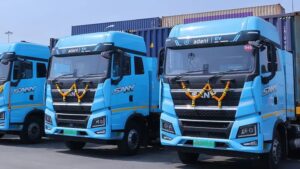




As India’s logistics ecosystem evolves from policy design to operational impact, the focus is shifting to execution, technology adoption, and resilience. With platforms like ULIP, AI-driven planning, and integrated infrastructure shaping daily operations, the sector’s success by 2026 will hinge on coordinated action, scalable investment, and supply chains that function as national economic assets.

Logistics transformation & resilience
Dr Surendra Ahirwar, IRTS, reflects on India’s logistics journey from policy vision to execution and highlights the transformative steps that have reshaped the sector. He notes that “when India created a dedicated Logistics Division in 2017, few imagined it would trigger a transformation that would ripple across the economy, influence international forums, and reshape supply chains.”
On the foundation of reforms, Ahirwar explains that the government’s early focus was clear: “Reduce logistics costs, promote seamless multimodal connectivity, digitalise processes for greater transparency, and develop skilled manpower for the sector.” The introduction of the LEADS index, he adds, “created healthy competition among states, pushing them to reform, innovate, and perform better. Logistics was no longer an afterthought but a pillar of economic policy.”
Highlighting the pivotal role of PM GatiShakti and the National Logistics Policy, Ahirwar emphasises, “For the first time, all infrastructure projects above ₹500 crore had to be integrated into a unified planning framework. Shared digital data helped avoid duplication, cut delays, and enable evidence-based decisions.” He underscores the importance of digital platforms, noting that “the Unified Logistics Interface Platform (ULIP) opened the door for digital integration, while the Sagar Setu platform modernised port operations.”
Ahirwar also stresses the international dimension of India’s logistics reforms: “Logistics reforms now span 45 ministries and 36 states and UTs. Discussions at global platforms like the G20, BRICS, and Indo-Pacific Economic Framework increasingly feature India’s logistics innovations.” Bilateral engagements, he adds, “underline the international recognition of India’s progress and its readiness to anchor resilient supply chains.”
On results, he points out that “India’s logistics cost has declined to 7.9% of GDP, while the PM GatiShakti master plan, with 1,600+ data layers, has enabled integrated, data-based planning for over 300 projects worth nearly ₹13.7 lakh crore.” He stresses that “logistics has shifted from a silent enabler to a frontline economic agenda, now recognised by policymakers, businesses, and citizens.”
Looking ahead, Ahirwar underscores the need for resilience: “Efficiency is no longer enough. Supply chains are not just corporate assets; they are national assets. Embedding resilience into supply chains will make India a trusted partner in global trade, delivering not just efficiency but stability.”
Concluding, he remarks, “India’s logistics story is more than cost reduction and efficiency gains. It is vision turned into reality, institutions working in tandem, and a country recognising that logistics is now centre stage in the economy. The challenge is to build future-ready, resilient supply chains that secure India’s economic ambitions and strengthen its role in the global economy.”
In 2026, resilient supply chains become national assets, not operational choices
ULIP, AI, and generative planning

Amol Apte, Vice President – Sales, CNB Logitech, notes that the Unified Logistics Interface Platform (ULIP) is already delivering tangible efficiency gains: “ULIP has integrated over 44 systems across 11 ministries and processed 180 crore+ API transactions,” resulting in “a 6% reduction in logistics costs” and significant savings on transit times and paperwork, with route optimisation and better coordination reducing costs by 10–20 percent on key logistics legs.
On monsoon-driven demand volatility, he explains that “AI/ML predictive analytics, leveraging historical sales, real-time market signals, and granular weather data, helps proactively plan inventory, dynamically route trucks, and maintain cold chains,” reducing spoilage and preventing stockouts caused by rain-related transport disruptions.
Looking ahead to 2026, Apte sees generative AI as a game-changer: “Gen AI can rapidly simulate thousands of end-to-end supply chain contingency plans, testing feasibility against unpredictable variables like policy changes, infrastructure outages, and extreme weather,” enabling proactive planning, faster decision-making, and stronger network resilience.
By 2026, generative AI will plan logistics faster than disruptions unfold
Strengthening manufacturing & logistics

Savio Monteiro, Partner, Financial Due Diligence, Deal Advisory, BDO India, observes that “India’s manufacturing and logistics ecosystem is still at an inflection point.” He emphasises that to reach a USD 5 trillion economy by 2030, India must “nearly double manufacturing’s share of GDP through higher capital formation, reliable supply chains, and deeper tech adoption across all enterprises.”
He proposes pragmatic, time-bound measures: “A 30–40% capital subsidy to build multimodal logistics parks, rail-linked private freight terminals, inland waterway cargo hubs, and urban last-mile consolidation centres” would strengthen the ecosystem. Additionally, “a concessional GST slab for certified multimodal operators and integrated logistics providers” can lower freight costs, while designating “10 industrial corridors as Green Freight Zones” will fast-track EV and hydrogen trucking.
Monteiro also highlights targeted fiscal support: “A reduced GST rate with capex incentives for electric trucks, lorries, and vans, and a National Logistics Single Window (NLSW) to remove border-checkpoint variability, harmonise state regulations, streamline approvals, and enforce uniform safety and compliance standards” are key steps to bolster efficiency, integration, and sustainability in India’s logistics sector.
India’s 2026 logistics strength depends on capital, corridors, and coordinated incentives
The Road Ahead:
Taken together, the perspectives in this feature make one message unmistakably clear: by 2026, India’s logistics success will be judged less by the strength of its policy frameworks and more by the consistency of their execution. Digital integration, risk-based regulation, infrastructure built at scale, and coordinated action across ministries and states must now converge into a daily operational reality. As logistics moves firmly to the centre of India’s economic and trade strategy, the next phase will be defined by outcomes: lower costs, faster clearances, resilient supply chains, and a system that works seamlessly for industry, agriculture, and global commerce alike.