


Aim is to boost operational safety, efficiency, and reduce vessel turnaround via automated ship mooring and unmooring processes.

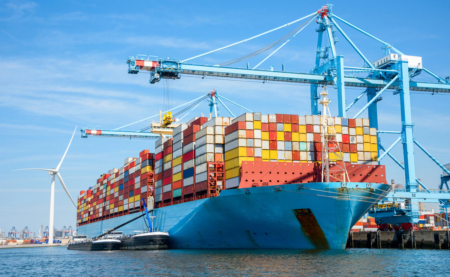
The largest state-owned container gateway in India, Jawaharlal Nehru Port Authority, aims to introduce the first Automated Mooring System (AMS) in India at one of its private terminals as a test project. The goal is to increase operating safety and efficiency and minimise vessel turnaround times by automating the mooring and unmooring procedures.
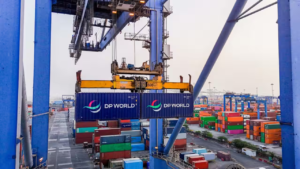
In order to choose a supplier to install the Automated Mooring System at Gateway Terminals India (GTI), which is 74 percent owned by APM Terminals Management, the container port operating division of the massive Danish shipping and transport business A P Moller-Maersk, the port authorities have published a tender.
Using ropes or cables to firmly bind a ship to a pier, quay, or buoy to keep it immobile in the face of wind, current, and tides is known as mooring.
A crew tosses heavy-duty mooring lines (ropes or wires) to port personnel as the ship moves closer to a berth. After that, the lines are connected to dock bollards.
Finding the perfect tension is essential to this process; it shouldn’t be too loose to allow the ship to wander or too tight to prevent breaking the ropes. The ship’s mooring winches aid in managing this tension.
According to Sunay Mukerjee, Chief Operating Officer, Gateway Terminals India, automating the mooring technique has various benefits.
These ropes are being physically held by the dockers today while they secure the ship by fastening them to the bollards. Mukerjee told the source, “That has enormous stored energy; if it happens to move, everyone nearby will be drowned and there is no chance of surviving.”
“Mooring operations are the only cause of fatal accidents in ports.” The Jawaharlal Nehru Port Authority’s Deputy Chairman, Unmesh Wagh, claims that “it is advantageous for me in terms of safety as a landlord port authority because you cannot put a price on safety.”
“The automated mooring system will entirely remove that danger,” said Mukerjee.
Efficiency is the second important advantage over present methods. Every minute is critical for port turnaround time. Currently, operations cannot start until the gangway is fixed and a vessel is fully secured. Before the lashes are sent up to start working, that entire process needs to be finished. We save vital time on both arrival and departure if this is automated,” Mukerjee said.
The effectiveness of the terminal’s crane operations will also be boosted by the automation of the mooring system, especially at a tidal port like J N Port.
“A ship surges up and down when berthed, regardless of whether it is monsoon or not. Efficiency is hampered since the crane operator must adjust during each up and down. If you have anything that keeps them more steady, the activities will go more smoothly and effectively. The crane operator will also gain from it, according to Mukerjee.
The opportunity for terminal managers to expand capacity without actually enlarging the berth is the third key benefit.
The opportunity for terminal managers to expand capacity without actually enlarging the berth is the third key benefit.
Because concrete is not elastic, it permits an artificial increase in capacity. My quay (berth) is 712 meters long. I can’t elaborate on that in either scenario. Due to the intersecting mooring ropes, I have to maintain space when berthing two vessels at the same time. Because of the surge and other reasons, there must be larger room during the monsoon, according to Mukerjee.
Because to the mooring lines, two ships at Gateway Terminals India must currently maintain a distance of 15 to 25 meters at all times.
“I can now move a 368-meter ship onto the berth where I have larger cranes, but the gap I have to maintain makes it difficult for me to move another 300-meter ship.” I can fit in a somewhat larger sailboat tomorrow when you don’t require the mooring lines. Mukerjee said, “I can probably squeeze that to 310 meters, and that will be the sweet spot in terms of the ship size typically calling at Nhava Sheva, where J N Port is located.”
Therefore, this may present a chance to improve capacity for terminals like Gate Terminals India, where there is no room for physical development. In a number of its ports, including Salalah, Tangier Med, and other European ports where we have experienced success, A P M Terminals has automated mooring systems. He asserted that it leads to notable increases in efficiency.
Wagh continued by stating, “The outcome will be a reduced turnaround time, allowing for the arrival of more vessels and a consequent rise in revenue.”
With a mooring period of 120 seconds or less, the automated system a vacuum coupled to the ship’s hull, should be able to function. The port authority stipulated in the tender documents that the technology must be able to unmoor the ship with a departure time of sixty seconds.
The system should be able to moor and unmoor container ships between 10,000 Deadweight Tonnage (DWT) and 150 meters of length overall (LOA) and 2,00,000 DWT and 400 meters of LOA.
SOURCE – ET INFRA