




India secures preferential access to the $30 trillion US market with major tariff cuts, zero-duty gains and strong sector safeguards.
India has achieved a landmark breakthrough in global trade diplomacy, securing preferential access to the United States’ $30-trillion market under the India–US Bilateral Trade Agreement, a move set to significantly boost exports, competitiveness and long-term economic growth across multiple sectors.
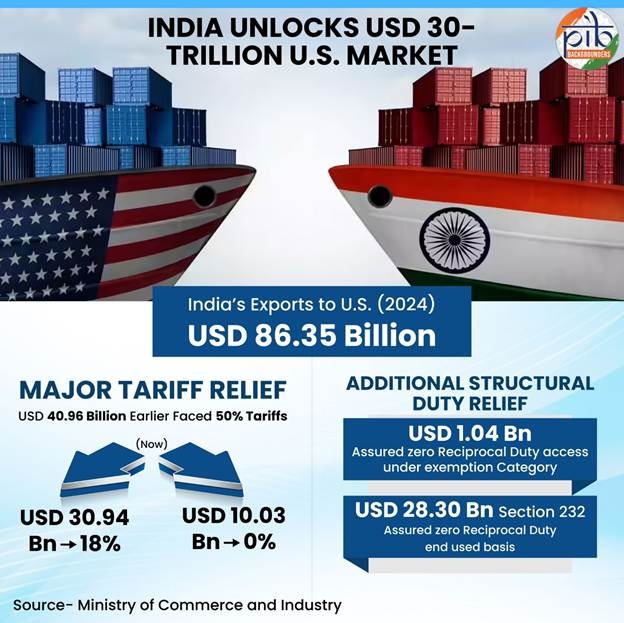
Announced by the Ministry of Commerce & Industry, the agreement delivers wide-ranging tariff rationalisation, zero-duty access across large export categories, enhanced digital and technology cooperation, and a calibrated framework to protect India’s farmers, MSMEs and sensitive domestic industries. India’s exports to the US stood at USD 86.35 billion in 2024, and the new framework sharply improves market access across textiles, leather, gems and jewellery, agriculture, machinery, home décor, pharmaceuticals and technology-led industries.
Key Trade Gains at a Glance
- Preferential access secured to a USD 30 trillion US market
- Highly competitive 18% tariff access on USD 900 billion of US global imports
- Zero-duty access on USD 150 billion of US global imports
- No additional duty on USD 720 billion of US global imports
- Exemptions retained on USD 350 billion of US global imports
- Preferential treatment under Section 232 tariffs
Major Relief on Reciprocal Tariffs
Reciprocal tariffs on Indian goods, earlier as high as 50%, have been sharply reduced:
- Of USD 40.96 billion in exports earlier facing high reciprocal tariffs:
- USD 30.94 billion now sees tariffs reduced from 50% to 18%
- USD 10.03 billion now enjoys zero-duty access
Sector-Wise Export Boost
Textiles & Apparel
- Tariffs cut from 50% to 18%
- Silk gets 0% duty access
- An opportunity opened in a USD 113 billion US market
- Benefits products such as garments, carpets, bed linen, yarn, baby clothing and home textiles
Leather & Footwear
- Tariffs reduced from 50% to 18%
- Enhanced access to a USD 42 billion US market
- Strong employment and MSME impact
Gems & Jewellery
- Tariffs lowered from 50% to 18%
- Zero-duty access for diamonds, platinum and coins covering a USD 29 billion market
- Overall opportunity in a USD 61 billion US market
Home Décor
- Tariffs cut from 50% to 18% in a USD 52 billion market
- 0% duty access for select products worth USD 13 billion, including chandeliers and illuminated signs
Toys
- Tariffs reduced from 50% to 18%
- Improved access to a USD 18 billion US market, benefiting Indian MSMEs
Machinery & Parts (Excluding Aircraft Parts)
- Tariffs reduced from 50% to 18%
- Opens access to a USD 477 billion US market
- India’s current exports: USD 2.35 billion
Agriculture: Growth with Strong Safeguards
- India maintains a USD 1.3 billion trade surplus in agriculture with the US
- USD 1.36 billion of agricultural exports receive zero additional US duty
- USD 1.035 billion assured zero reciprocal tariff for stability
Zero-Duty Agricultural Products Include:
Spices, tea, coffee, fruits, nuts, cereals, processed foods, coconut products, cocoa preparations, sesame and poppy seeds, fruit pulps and juices.
Fully Protected Sensitive Sectors:
Dairy, meat, poultry, cereals, millets, pulses, oilseeds, GM foods, animal feed, honey, ethanol for fuel, tobacco and select fruits.
Zero-Duty Industrial Exports
- USD 38 billion in industrial exports gain zero additional duty
- Covers aircraft parts, machinery, pharmaceuticals, auto parts, gems, chemicals, plastics, rubber, paper and wood products
Structural Competitive Advantage
Indian exporters gain a strong edge as competing suppliers continue to face higher tariffs:
- China: 35%
- Vietnam & Bangladesh: 20%
- Malaysia, Indonesia, Philippines, Cambodia & Thailand: 19%
Digital Trade and Technology Cooperation
- Global digitally delivered services exports rose to USD 4.78 trillion in 2024
- India’s digital services exports reached USD 0.28 trillion, growing 10.3% YoY
- India ranks 5th globally in digital services exports
- Enhanced access to semiconductors, AI chips, data centre hardware and advanced ICT components
Consumer Welfare and Manufacturing Support
The agreement enables calibrated imports of select consumer goods and critical intermediate inputs, supporting price stability, manufacturing competitiveness and deeper integration into global value chains, without disrupting domestic production.
A Forward-Looking Strategic Partnership
By unlocking access to a USD 30-trillion market, delivering deep tariff cuts, securing zero-duty benefits and strengthening digital and technology cooperation, while safeguarding sensitive sectors, the India–US Bilateral Trade Agreement positions India for sustained export-led growth, stronger global integration and long-term economic resilience.
Source: PIB