




With FTAs now in place with 38 nations, Prime Minister Modi called the milestone unprecedented in India’s trade history, noting that merchandise trade with Australia and the UAE has doubled since FTAs were signed.
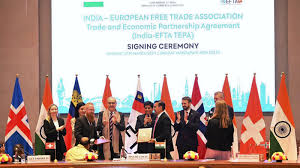
The Trade and Economic Partnership Agreement between India and the four member states of the European Free Trade Association, Iceland, Liechtenstein, Norway and Switzerland, marked its second anniversary on 10th March 2026, with the agreement now in active implementation following its entry into force on 1st October 2025.
EFTA’s commitments under the agreement cover 92.2 per cent of tariff lines, accounting for 99.6 per cent of India’s exports, including full coverage of non-agricultural products and tariff concessions on processed agricultural products. India’s commitments cover 82.7 per cent of tariff lines, accounting for 95.3 per cent of EFTA exports. Sensitive sectors including dairy, soya, coal and select agricultural products are protected, while the effective duty on gold remains unchanged.
Commerce and Industry Minister Piyush Goyal said the agreement creates an investment pathway of 100 billion dollars over 15 years and improves access to specialised machinery, quality inputs and technology partnerships that can strengthen manufacturing in India. The agreement carries binding commitments across pharmaceuticals, textiles, engineering goods, chemicals, processed foods and marine products.
The agreement also carries an inclusive growth dimension, with opportunities expected to expand across Indian states including Maharashtra in grapes, Karnataka in coffee, Kerala in spices and seafood, and the North Eastern states in horticulture. The Government has articulated a target of 1 trillion dollars each in merchandise and services exports by 2030, with the EFTA agreement forming a key part of that strategy.