



Centre launches ₹25,060 cr export mission and enhances the logistics framework to mitigate global disruption for MSMEs.
In response to ongoing global logistics disruption, which has resulted in considerable cost hikes and supply chain bottlenecks, the Ministry of Commerce & Industry has revealed a comprehensive strategy to strengthen India’s trade competitiveness, particularly for its exporting community. The Center’s strategy is centred on bolstering the country’s logistical infrastructure and supporting the Export Promotion Mission (EPM), a major financial project.
The recently authorised Export Promotion Mission (EPM), a bold government initiative revealed in the Union Budget 2025–2026, is essential to this plan. The EPM would operate from the fiscal years 2025–2026 through 2030–2031, with a significant budget of Rs. 25,060 crore. This mission represents a strategic break from several smaller programs by offering an adaptable, outcome-based, and digitally driven framework for export promotion. Its main goal is to increase India’s export capacity, particularly for labour-intensive industries, first-time exporters, and Micro, Small, and Medium Enterprises (MSMEs).
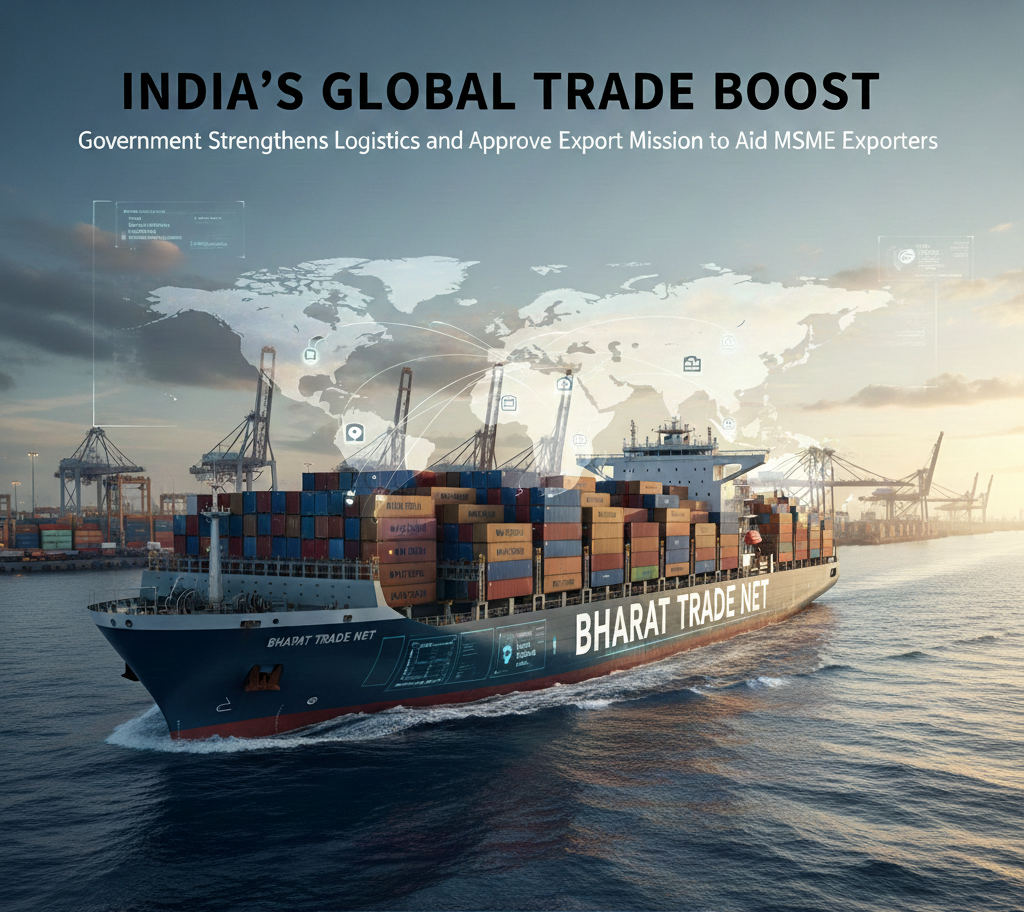
In order to improve multimodal connectivity and lower total supply chain costs, the government is simultaneously building logistics infrastructure through well-known initiatives like PM Gati Shakti and the National Logistics Policy. The Bharat Trade Net (BTN) is a vital piece of digital public infrastructure. About 30 important trade documents will be digitised by BTN, simplifying processes to conform to international standards such UNCITRAL’s MLETR. This would greatly reduce the burden of compliance and transaction costs for exporters, especially MSMEs.
A number of programs offer focused assistance in addition to the EPM. With 100 percent credit guarantee coverage from the National Credit Guarantee Trustee Company Limited (NCGTC), a Credit Guarantee Scheme for Exporters (CGSE) has been created to provide qualifying exporters, including MSMEs, with additional credit facilities up to Rs. 20,000 crore. The goal of this action is to support liquidity and efficient corporate operations. Additionally, the International Cooperation Scheme reimburses MSMEs for their participation in international trade events and pays for new Micro and Small exporters’ initial export-related expenses, such as obtaining Registration-cum-Membership Certificates (RCMC).
To shield exporters from the dangers of international trade, the Export Credit Guarantee Corporation of India (ECGC) has put in place particular safeguards. To encourage lending to MSE exporters, they include providing collateral-free coverage under the WT-ECIB for export credit working capital limits up to ₹10 crore. Additionally, they have increased the bank cover percentage to 90 percent for small exporter accounts (up to a maximum of ₹80 crore), provided that banks provide highly rated accounts with a lower interest rate. Additionally, the ECGC lowers the collateral need for bank loans by offering exporters who deal directly with the corporation up to 100 percent coverage.
Through initiatives like the India-Africa Conclave, the government is aggressively working to increase India’s market share in developing nations like Africa and Latin America. Since September 2025, the ECGC has improved the country ratings for 24 countries in the Middle East, East Asia, Africa, and Latin America in an effort to lower insurance costs and promote diversification away from restrictive markets. Lastly, industries concentrating on value-added traditional exports receive specialist incentives. For example, the Coir Board operates the Coir Vikas Yojana (CVY) to promote sustainable growth, providing support for quality certification and participation in international trade shows, while the Spices Board implements the SPICED plan for competitive advancement.
SOURCE – PIB