


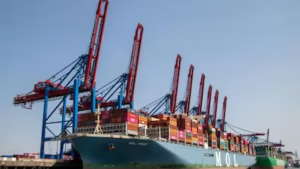


Food and industrial supply chains are evolving into intelligent, self-optimising ecosystems powered by AI, IoT, and predictive analytics. From climate resilience to autonomous planning, digital orchestration is redefining freshness, agility, and trust at scale.

Supply chains must sense, decide, and act autonomously
Resilient food supply chains
Shyam Yadav, Global Lead – IT & Supply Chain at Cargill, frames climate resilience as a fundamental design principle rather than a contingency. “Companies are adopting AI-led yield forecasting, hyperlocal climate intelligence, and satellite-based soil mapping to anticipate risks before they disrupt supply,” he explains. Diversified sourcing clusters and mobile aggregation points allow rapid rerouting during heat waves or heavy rainfall. One notable example: fruit exporters reduced climate-driven losses by 18 percent using predictive harvest timing combined with satellite moisture mapping and mobile packhouses close to fields. Yadav emphasises that integrated climate-response frameworks are transforming uncertainty into orchestrated, manageable action.
Environmental sensors: Proactive protection
IoT and environmental sensing have evolved from monitoring tools to active protection systems. “Reefers now automatically adjust temperature or airflow, and deviation alerts trigger instant route changes,” Yadav explains. Predictive spoilage algorithms prevent damage before it spreads. A dairy network deployed ATP-based quality sensors and AI-driven deviation models, cutting spoilage by 31 percent. Across the food supply chain, sensor intelligence is ensuring freshness and safety while minimising human dependency.
Strengthening first- and last-mile cold chains
Yadav highlights the critical edge of cold chains. “Investments in solar packhouses, micro cold rooms, urban multi-temperature cross-docks, and EV-based reefer fleets are reshaping first- and last-mile logistics,” he says. An integrated multimodal cold corridor linking road, rail, and sea helped a leading vegetable supplier improve freshness by 23 percent. Modular, scalable infrastructure is key to adapting global standards to emerging markets, ensuring quality from farm to fork.
Predictive analytics for waste reduction
AI-driven predictive analytics now guides planning, production, and logistics decisions simultaneously. “Applications like AI demand sensing, predictive shelf-life models, automated FEFO picking, and spoilage simulations are becoming standard,” Yadav notes. One poultry processor reduced downgrades by 18 percent through pallet-level aging predictions and optimised cut planning. Predictive quality models are helping companies move from waste reduction toward complete waste prevention.
Next-Gen capabilities for 2026
Looking ahead, Yadav believes the food sector will rely on autonomous, orchestrated ecosystems. “End-to-end digital twins, unified traceability, autonomous routing, next-gen bio-sensing, and GenAI copilots will define supply chains that think, predict, and act independently,” he explains.
The vision is clear: touchless, self-managed supply chains delivering freshness with precision, building trust through transparency, and running efficiently with minimal human intervention.
Intelligent supply chain technologies

Supply chains are becoming intelligent and increasingly self-optimising.
Sachin Bajaj, Global Lead – Supply Chain Strategy at Akzo Nobel, underscores that 2025 marked a defining year for supply chain transformation. “Digital acceleration has moved from being an operational enhancement to a strategic imperative,” he explains. Among the technologies making the most impact were AI-enabled visibility platforms, IoT-driven telemetry, and cloud-native control towers. The convergence of real-time sensing with intelligent analytics allowed organisations to move from passive monitoring to predictive orchestration, significantly improving resilience in a volatile global environment.
AI and machine learning in forecasting
AI and machine learning matured across forecasting, demand sensing, and exception management. Bajaj notes, “ML models now combine historical patterns with macroeconomic indicators, weather disruptions, and market sentiment, delivering more accurate forecasts and faster detection of demand shifts.” Prescriptive AI is also increasingly used in operational workflows, automating exception handling, classifying risks, recommending actions, and triggering automated responses, enabling supply chain leaders to act decisively under uncertainty.
Challenges in interoperability
Despite technological advances, Bajaj highlights persistent hurdles in interoperability. “Fragmented platforms, non-standard data formats, and limited API maturity still restrict seamless information flow across shippers, carriers, 3PLs, and technology providers,” he observes. End-to-end visibility remains challenging when key datasets are trapped in legacy or proprietary systems. Overcoming these barriers will require industry-wide data governance, shared standards, and a collaborative mindset among all stakeholders.
Digital twins and control towers evolving
Digital twins and control towers have evolved beyond operational dashboards into strategic, scenario-driven decision systems. “The new generation integrates network design, demand planning, transportation optimisation, and sustainability analytics into continuously learning models,” Bajaj explains. Control towers now provide proactive risk sensing and simulation capabilities, enabling leaders to assess disruptions and make informed decisions in near real-time.
Emerging technologies shaping 2026
Looking toward 2026, several emerging technologies promise to redefine planning and execution. Bajaj points to generative AI for autonomous planning copilots, edge-enabled IoT for high-fidelity data, blockchain-based traceability, robotics, smart warehousing, and autonomous transport ecosystems. He adds, “Supply chains are becoming intelligent, interconnected, and increasingly self-optimising, where agility and resilience will define competitive advantage.”
Strategic takeaways
- Predictive orchestration through AI and IoT is key to resilience.
- Prescriptive analytics enhances forecasting and exception management.
- Collaborative data governance will unlock true end-to-end visibility.
- Digital twins and control towers are strategic decision enablers.
- Emerging technologies will drive autonomous, self-optimising supply chains.