



India’s first underwater road-rail tunnel to cut freight time, improve mobility and drive Northeast growth.
The Cabinet Committee on Economic Affairs (CCEA), chaired by Prime Minister Narendra Modi, has approved a ₹18,662.02 crore infrastructure project for the construction of a 4-lane access-controlled greenfield corridor with a twin-tube underwater road tunnel beneath the Brahmaputra River in Assam.
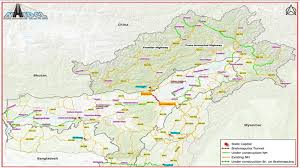
The 33.7 km corridor will connect Gohpur on NH-15 with Numaligarh on NH-715 and includes a 15.79 km road-cum-rail tunnel, with two road lanes in each tube and provision for railway infrastructure in one tube. Once completed, it will be India’s first underwater road-and-rail tunnel and only the second such project globally.
From a logistics and freight perspective, the project is expected to be transformational. At present, movement between Gohpur and Numaligarh involves a 240-km journey taking nearly six hours via the Kaliabhambhora bridge, passing through congested and environmentally sensitive stretches, including Kaziranga National Park. The new corridor will significantly reduce distance, transit time and fuel consumption, improving freight reliability and lowering logistics costs across the Northeast.
The project strengthens multimodal integration by linking NH-15 and NH-715 with two key railway sections of the Northeast Frontier Railway—Rangia–Mukongselek on the Gohpur side and Furkating–Mariani on the Numaligarh side. It also connects eight logistics nodes, 11 economic nodes, four major railway stations, two airports (Itanagar and Tezpur) and two inland waterway terminals at Biswanath Ghat and Tezpur, enabling smoother movement of goods and passengers.
Beyond logistics, the corridor is expected to play an important role in regional connectivity, strategic mobility and socio-economic development. It will improve access between Assam, Arunachal Pradesh, Nagaland and other Northeastern states, support industrial growth, enhance tourism connectivity, and strengthen national integration.
The project is projected to generate around 80 lakh person-days of direct and indirect employment and is expected to catalyse long-term development in surrounding regions. With an estimated annual average daily traffic of 4,680 PCUs in FY25, the corridor marks a significant step in building future-ready, multimodal infrastructure for India’s Northeast.
Source: PIB