



India, Switzerland review TEPA roadmap as pact targets USD 100 bn investment and 1 million jobs.
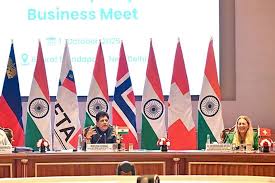
Union Minister of Commerce and Industry Piyush Goyal held a high-level meeting with Guy Parmelin, President of the Swiss Confederation, reaffirming the shared commitment to deepen economic and strategic cooperation under the **India–EFTA Trade and Economic Partnership Agreement (TEPA).
The meeting took place during President Parmelin’s official visit to India to attend the India AI Impact Summit 2026. Both sides underlined the need to balance innovation with responsibility and highlighted TEPA’s potential to catalyse technology collaboration in precision engineering, health sciences, renewable energy, and research and development.
Highlighting India’s growth momentum, Shri Goyal said India is the world’s fourth-largest economy, with an estimated GDP of USD 4.51 trillion in 2026, offering scale, reform-led momentum, a large consumer base, and infrastructure-driven competitiveness. He encouraged increased Swiss investment, particularly in niche technology-led sectors, and reiterated India’s role as a reliable global supplier of affordable, high-quality medicines and vaccines. Deeper cooperation in R&D, biotechnology, speciality pharmaceuticals and advanced therapeutics was also emphasised.
Both leaders reaffirmed their intent to enhance investment flows, regulatory cooperation and institutional engagement, noting the dedicated EFTA Desk at Invest India as a facilitation mechanism for Swiss companies expanding in India.
TEPA, India’s first free trade agreement with a developed EFTA bloc comprising Iceland, Liechtenstein, Norway, and Switzerland, is also India’s first operational trade agreement with a European economic bloc. The agreement opens access for “Make in India” products to Switzerland’s USD 1.0 trillion market.
Under TEPA, EFTA has offered improved market access on 92.2% of tariff lines, covering 99.6% of India’s exports, including concessions on processed agricultural products. States such as Maharashtra (grapes), Karnataka (coffee), Kerala (spices and seafood) and the Northeastern states (horticulture) are set to benefit, while India has safeguarded sensitive sectors like dairy, soya and coal and addressed PLI-linked sensitivities in pharma, medical devices and processed food.
The agreement carries an ambition to facilitate USD 100 billion in investments into India and support the creation of one million direct jobs, reinforcing confidence that sustained high-level engagement will drive long-term prosperity for both countries.
Source: PIB